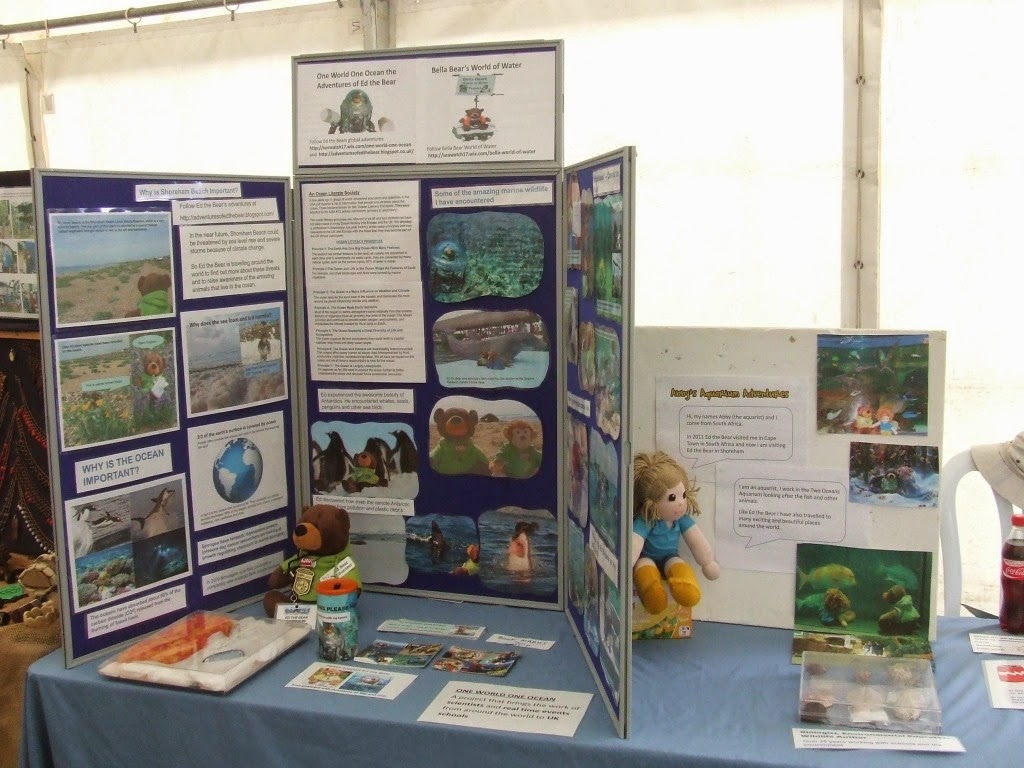
Here we are again at the EYE summit, EYE stands for Eco Young and Engaged.
Wednesday, 18 June 2014
Eco Schools Summit
Here we are again at the EYE summit, EYE stands for Eco Young and Engaged.
The project shares sustainable living ideas be tween schools and they have the chance to show case what they are doing in their school to save energy, recycle or help wildlife in their school grounds. There are also exhibits from lots of organisations and also workshops that the children can take part in to learn more.
We had our stand set up in the main hall as usual and this year Steve ran workshops on dolphin rescue. During the workshops the children learned about dolphins and that sometimes they become stranded on the shore. The children learned about the first aid they could give a dolphin to keep it alive until the marine rescue team could arrive.
A stranded dolphin can easily die from heat exhaustion (gthey get to hot when not in water) from gravity - the dolphins own body weight when not supported by water can crush its organs such as its lungs and heart and other problems the children had top learn about before they could plan their rescue.
In the workshops the scenario was that a dolphin had become stranded on the beach entangled in plastic.
The children, in two groups, had to use what they had learned to plan their rescue and then undertake their rescue.
All the children in the workshops did really well and it they found a dolphin in real life they should be able to keep it alive. After the rescue we did a debrief of their rescues to find out from the children how well they think their rescue we and discussed the problems of plastic pollution in the ocean
They also handled some whale bones, this is a vertebra from a dead stranded killer whale backbone
While Steve was doing the workshops, Abby helped me and Bella on the display stand.
It was a great day and the children were very excited and interested to hear about the ocean and also about conservation. Thanks for the help Abby.
Labels:
E Y E Project,
Eco Schools,
Young Eco and Engaged
Sunday, 15 June 2014
Adur World Oceans Day Event
Yesterday I took Abby along with me and Bella to our annual World Oceans Day Event.
The display also explained why my beach at Shoreham is so special and was made a nature reserve because of the rare vegetated shingle plants.
We set up our stand as usual that told people about the oceans and why they are important, such as how the create our climate and weather, provide freshwater, food, oxygen and much more.
I also included some information about when I visited Abby in South Africa so everyone would know who she was.
Abby also helped me to explain about ocean acidification and how more than normal amounts of carbon dioxide from the air are entering the oceans and changing the water chemistry. This is making it harder for corals and shellfish to build those beautiful tough shells.
An experiment of the stand using vinegar and a sea shell shows the science behind ocean acidification.
Abby was a great help but I said she could go and look around the other displays to what other people are doing.
She checked out the stand by Friends of Shoreham Beach N
ature Reserve that had a display about the plants, wildlife but also the beach litter.
She checked out an aquarium tank...
...and also a lobster
She even met claws from the Sussex Wildlife Trust Stand
Abby then had a chat with Bell and helped on her part of the stand. As you know Bella is exploring why freshwater is the most valuable substance on the planet - which of course also comes from teh ocean.
Bella helps out at the Lewes Railway Land Nature Reserve where there is lots of fresh water and pond life. Bella is exploring freshwater in nature and how people use water and how in the UK people often waste water because it is so plentiful. But in some parts of the world its very scarce.
Bella will soon be traveling to the Amazon Rainforest with Amazon Rainforest Workshops to learn about this amazing place, the wildlife and how even here not everyone has clean drinking water.
The day went really quickly as there was so much to do and so many people to talk to.
It wa sonly after the evnt that I got the chance to have a chat properly with Abby and find out what she had been doing since I visited her.
The display also explained why my beach at Shoreham is so special and was made a nature reserve because of the rare vegetated shingle plants.
We set up our stand as usual that told people about the oceans and why they are important, such as how the create our climate and weather, provide freshwater, food, oxygen and much more.
I also included some information about when I visited Abby in South Africa so everyone would know who she was.
Abby also helped me to explain about ocean acidification and how more than normal amounts of carbon dioxide from the air are entering the oceans and changing the water chemistry. This is making it harder for corals and shellfish to build those beautiful tough shells.
An experiment of the stand using vinegar and a sea shell shows the science behind ocean acidification.
Abby was a great help but I said she could go and look around the other displays to what other people are doing.
She checked out the stand by Friends of Shoreham Beach N
ature Reserve that had a display about the plants, wildlife but also the beach litter.
She checked out an aquarium tank...
...and also a lobster
She even met claws from the Sussex Wildlife Trust Stand
Abby then had a chat with Bell and helped on her part of the stand. As you know Bella is exploring why freshwater is the most valuable substance on the planet - which of course also comes from teh ocean.
Bella helps out at the Lewes Railway Land Nature Reserve where there is lots of fresh water and pond life. Bella is exploring freshwater in nature and how people use water and how in the UK people often waste water because it is so plentiful. But in some parts of the world its very scarce.
Bella will soon be traveling to the Amazon Rainforest with Amazon Rainforest Workshops to learn about this amazing place, the wildlife and how even here not everyone has clean drinking water.
The day went really quickly as there was so much to do and so many people to talk to.
It wa sonly after the evnt that I got the chance to have a chat properly with Abby and find out what she had been doing since I visited her.
Saturday, 14 June 2014
Abby the Aquarist visits Ed the Bear
You may remember in 2012 I visited Abby the Aquarist and Heidi in South Africa. We had a great time and Abby showed me around the Two Oceans aquarium, a sea bird sanctuary and saw lots of penguins and many otehr things. The first day can be seen at the following link - but check out all the otehr days imwas with Abby as well.
http://adventuresofedthebear.blogspot.co.uk/2012/01/ed-arrives-safely-in-south-africa.html
Abby has been on some great adventures of her own and you can see what she has been up to on her own weblog
http://abbysaquariumadventures.blogspot.co.uk/
I am sure we will have a great time.
Bye, Ed and Abby
http://adventuresofedthebear.blogspot.co.uk/2012/01/ed-arrives-safely-in-south-africa.html
Abby has been on some great adventures of her own and you can see what she has been up to on her own weblog
http://abbysaquariumadventures.blogspot.co.uk/
I am sure we will have a great time.
Bye, Ed and Abby
Saturday, 29 March 2014
Earth Hour
Hi all
Earth Hour has come around again to raise
awareness of our planet. If you don’t know Earth Hour the aim is to encourage
as many people as possible each year to not use electric lights (and other
electrical devices) between 8.30 and 9.30pm which is where it all started. This
is a global event and there are also many fund raising projects linked to Earth
Hour to raise money for various causes.
Me and Bella celebrating Earth Hour 2014
‘Earth Hour is a worldwide grassroots movement uniting people to protect
the planet, and is organised by WWF. Engaging a massive mainstream community on
a broad range of environmental issues, Earth Hour was famously started as a
lights-off event in Sydney, Australia in 2007. Since then it has grown to
engage more than 7000 cities and towns worldwide, and the one-hour event
continues to remain the key driver of the now larger movement’.
Friday, 28 February 2014
Fascianting objects washed up after the storms
Hi all
We have had some terrible stormy weather this last few weeks, heavy rain, strong gale force wind. The beach is not a safe place for a small bear like me.
But today the sun is shining and the wind has reduced to a pleasant breeze and so I have ventured out onto Shoreham Beach with my buddy Steve who working with a school group to look at the things washed up by the stormy seas.
We found lots of egg cases. These egg cases were laid by the common whelk
These egg cases are from the cat shark family (also called a dogfish) the smaller bronze coloured egg case at the top of the photo
The larger egg case is from a Ray
Some types of ray are becoming rare around the UK because they have been over-fished. The Shark Trust run a project called the great egg case hunt, encouraging people and groups to collect and identify the egg cases they find and send the information to the Trust.
We have had some terrible stormy weather this last few weeks, heavy rain, strong gale force wind. The beach is not a safe place for a small bear like me.
But today the sun is shining and the wind has reduced to a pleasant breeze and so I have ventured out onto Shoreham Beach with my buddy Steve who working with a school group to look at the things washed up by the stormy seas.
We found lots of egg cases. These egg cases were laid by the common whelk
These egg cases are from the cat shark family (also called a dogfish) the smaller bronze coloured egg case at the top of the photo
The larger egg case is from a Ray
Some types of ray are becoming rare around the UK because they have been over-fished. The Shark Trust run a project called the great egg case hunt, encouraging people and groups to collect and identify the egg cases they find and send the information to the Trust.
They are using this information to find the nursery grounds of the rays so that they can be protected. You can take part too, just click on this link to find out how. http://www.sharktrust.org/en/great_eggcase_hunt/
Steve gave the children some ID sheets. One sheet looked at strand line objects and how to identify different ray eggs. Another sheet was for identifying seaweeds.
Lots of seaweed had been washed up after the storms, including this big brown seaweed called oarweed.
Some animals live actually attached to seaweeds, such as these spiral tube worms. The worms live in a spiraled tube rater like a seashell.
We also found different types of sponge
There were also lots of cuttlefish bones too
The pupils from the school found lots of interesting items and then Steve told them lots of fascinating facts about the objects they had collected.
We also found plastic and other litter on the beach
There was a small bird feeding on the beach but it flew of and sat on the pebbles so we would not be able to see it easily.
The colours of the pied wagtail blended in well with the pebbles.
The children had a great time on the beach learning about the strandline objects and the clues they give us to life off the beach.
Later we foud a bottle with some goose barnacles attached to it. Goose barnacles attach to floating objects, which nowadays also inlcudes plastic.
I wonder how far the bottle had floated before it was washed up on our beach at Shoreham
Bye for now
Ed the Bear
Saturday, 15 February 2014
Ed the Bear at the Brighton Science Festival 2014
Hi all
Well we are back at the Brighton Science Festival again this year. http://www.brightonscience.com/2014/
As before the event is hosted by Hove Park School, which is also the school where Steve's daughter goes to 6th Form College.
As usual we took a display about my travels
Our display looks at our local beach at Shoreham where I live and how its connected to the global ocean. The beach is a nature reserve where the Friends of Shoreham Beach and the management group help look after the rare vegetated shingle habitat and during my travels I have been finding out how global issues such as climate change and plastic debris might endanger the beach at Shoreham.
The Friends of Shoreham Beach also had a fascinating stand telling people why Shoreham Beach is so special.
They also had a sea bird quiz and a beach litter quiz.
Steve did two talks during the day. The first talk was about the ocean and why its important. The ocean controls our weather and climate, provides freshwater, oxygen, medicines food and much more
I also had a visit from a young visitor who had brought his class bear to see me. the bear was called Barnaby. Each child in the class takes Barnaby home for a week and writes a journal of what the bear has been doing.
This is me with Barnaby.
In between the talks people could also watch a TED Talk by Sylvia Earle a legendary ocean researcher who has done so much to help our understanding of the oceans and share the message to others
You can see this inspiration talk by clicking the link below
http://www.youtube.com/watch?v=43DuLcBFxoY
It was an amazing day and we were able to share my message with lots of visitors.
Bye for now, Ed the Bear
Well we are back at the Brighton Science Festival again this year. http://www.brightonscience.com/2014/
As before the event is hosted by Hove Park School, which is also the school where Steve's daughter goes to 6th Form College.
As usual we took a display about my travels
Our display looks at our local beach at Shoreham where I live and how its connected to the global ocean. The beach is a nature reserve where the Friends of Shoreham Beach and the management group help look after the rare vegetated shingle habitat and during my travels I have been finding out how global issues such as climate change and plastic debris might endanger the beach at Shoreham.
The Friends of Shoreham Beach also had a fascinating stand telling people why Shoreham Beach is so special.
They also had a sea bird quiz and a beach litter quiz.
Steve did two talks during the day. The first talk was about the ocean and why its important. The ocean controls our weather and climate, provides freshwater, oxygen, medicines food and much more
The second talk later in the afternoon was called an Ocean of Plastic and looked at plastic and the problems of pollution from plastic including animals that accidentally swallow plastic (including plankton) and animals that become entangled. The talk looked at plastic debris on Shoreham Beach as well as global locations.
We explored that plastic is a good invention, but things that we only use once or twice should not be made of plastic because it takes a long time to breakdown.
You may remember I vised the TrueCost Supermarket Art Installation in Brighton which was all about beach litter and plastic pollution http://adventuresofedthebear.blogspot.co.uk/2013/12/ed-bear-visits-dirty-beach-exhibition.html
As usual we had our display about ocean acidification. Increased carbon dioxide in the atmosphere, caused by human activities, has led to an increase of carbon dioxide in the oceans. This is now changing the water chemistry of the ocean. Part of this display is a sea shell in vinegar to show the effects of a wek acid on a shell.
This year we also included an additional experiment run by Steve's daughter Amber. We used a pH meter show how by blowing into a jar of water, the carbon dioxide in our breath would change the pH.
We tested the water first so people could see the pH value. We then got people to blow into the water through a straw and they could see the pH change making it more acidic.I also had a visit from a young visitor who had brought his class bear to see me. the bear was called Barnaby. Each child in the class takes Barnaby home for a week and writes a journal of what the bear has been doing.
This is me with Barnaby.
In between the talks people could also watch a TED Talk by Sylvia Earle a legendary ocean researcher who has done so much to help our understanding of the oceans and share the message to others
You can see this inspiration talk by clicking the link below
http://www.youtube.com/watch?v=43DuLcBFxoY
It was an amazing day and we were able to share my message with lots of visitors.
Bye for now, Ed the Bear
Friday, 14 February 2014
Ocean Literacy Statement virtual signing
Hi
You may remember that me and my buddy Steve took part in the Transatlantic Ocean Literacy Conferee last September. http://adventuresofedthebear.blogspot.co.uk/search?updated-max=2013-09-12T07:58:00-07:00&max-results=7
Well my buddy Steve took part in a group signing of the vision statement yesterday to take forward what was achieved at the conference and to lead to the next stage.
When I am traveling in the USA I work with schools that have Ocean Literacy in their school curriculum. One of the aims of the conference is to integrate ocean literacy into the UK and European schools curriculum
Fantastic news
Bye for now, Ed the Bear
You may remember that me and my buddy Steve took part in the Transatlantic Ocean Literacy Conferee last September. http://adventuresofedthebear.blogspot.co.uk/search?updated-max=2013-09-12T07:58:00-07:00&max-results=7
Well my buddy Steve took part in a group signing of the vision statement yesterday to take forward what was achieved at the conference and to lead to the next stage.
When I am traveling in the USA I work with schools that have Ocean Literacy in their school curriculum. One of the aims of the conference is to integrate ocean literacy into the UK and European schools curriculum
Fantastic news
Bye for now, Ed the Bear
Subscribe to:
Posts (Atom)