Showing posts with label Thunder Bay National Marine Sanctuary. Show all posts

Wednesday, 21 April 2010

Diving in Thunder Bay

Hi everyone!

I got a chance to go exploring today on one of Thunder Bay’s shipwrecks. The trip started with a short drive and then a quick hike to reach a good spot to dive into the water.
“The hike out to the site was worth the trip on its own, but it only got better from there!”


I really enjoyed this walk out on the beach where we entered the water for the short swim to the shipwreck. We were going out on a dive to document the shipwreck of the Portland, a schooner wrecked in a storm in 1877. The ship lost control and was driven ashore where it was broken apart by the large waves and rocks. Fortunately the crew got away safely before the ship fell apart. I got to tag along with my diving bubble to see this shipwreck firsthand with a few of the sanctuary’s divers.

“The schooner Portland would have looked like this one in the 1870’s”


The Portland lies in very shallow water and is just a few hundred feet offshore, so it was a very short trip over the sand and rocks that lead out to the shipwreck.  I was just getting used to the movement of the dive bubble and looking out through the glass in my diving bubble into the clear water when suddenly I saw a unusual shape looming in the distance. As my eyes focused, the different pieces of wood that made up the sailboat started to take shape very quickly.
The wooden boat we saw was made up of three layers sandwiched together. We were looking down at the inside of the ship, where you can see the planks that run the length of the boat. The frames run vertically up and down the sides to add structural strength to the ship and then the outer hull planks run the length of the ship like the inner planks to keep the water out. Those are on the bottom layer we’re looking at today.

The bottom and one side of this ship are still visible out in the water, and we got to explore all of it while we were out over the wreck. This was a really fun experience for me, and Steve told me that the shallow shipwrecks in Thunder Bay are a great way to learn more about the ways that these ships were constructed long ago. I have seen models and painting of the vessels that used to visit my local harbour in bygoen days, but I have never been this close to a real historical vessel. I’m so glad I got to see one of the shipwrecks my friends at Thunder Bay are working hard to help protect up close. Thanks to the divers who helped me to have this opportunity! Also a special thanks to Ed at IRobot who built my diving bubble for me, or I would have to just watch from the surface.
“This picture was taken while we explored the front of the shipwreck (called the bow). The large metal tube you see is where the anchor chains passed through”

“This is a picture of me next to the keelson of the Portland. This part of the ship functions as the backbone of the whole boat here in the Great Lakes. No wonder it’s so big!”

I have to go for now, we have a big Earth Day celebration planned tomorrow, and there’s a lot of work to do.

By for now! Ed.

Saturday, 17 April 2010

Regional MATE ROV Competition

Hi all!

Yesterday Sam and I helped the team at Thunder Bay get ready for the Great Lakes Regional MATE ROV Competition. We had no idea what an ROV competition was, so we asked Steve to explain. He told us that an ROV is an underwater robot that scientists use to explore areas they can’t get to. especially areas that are too dangerous or too deep for a person to travel too.

In the MATE ROV Competition students from age 11 to 18 build robots and compete in challenges (missions). Sam and I were happy to hear that this year’s competition is all about undersea volcanoes. We know a lot about those from our visit to Hawaii. Today we woke up early and headed to the competition.
Here’s a picture of Sam and I working at the registration table as greeters for the ROV Competition”

Sam and I talked to a few of the teams and all of the kids seemed really excited. We watched students put their ROVs (robots) in the pool and drive them underwater.

They had many missions. The two I liked were navigating through caves and picking up crustaceans (like crabs and lobster).
Sam and I also helped judge the posters students had created to explain their ROV.

Bye for now, Ed

Friday, 16 April 2010

Education is Fun at Thunderbay

Hi everyone!

We have had a very busy schedule here at Thunder Bay already this week. We had learned a little bit about the sanctuary’s shipwrecks, so Sam and I asked if we could help spread the word about protecting these shipwrecks with some of the education staff. They were very happy to have our help, and we had a great time talking with the students!

“Here is a picture of Sam and I getting ready to help out with a local classroom at the Alpena City Marina”

Early this week we went out to the Alpena Marina and helped the sanctuary’s Great Lakes Science Initiative partners from Sanborn Elementary. They are building Remote Operated Vehicles to study zebra mussels, an invasive species here in the Great Lakes. The class will use their underwater robots to document zebra mussels on shipwrecks in the sanctuary and to study the Thunder Bay River, an area the zebra mussels have also populated.

The students met with Angie, an educator with the U.S. Fish and Wildlife Service to learn more about water quality. This made Sam very happy, as he says good water always makes him feel better.

We helped the students take samples of water to test its clarity and pH and to see what creatures were living in it.
“I’m helping out as a tether handler for the student’s ROV”

The students used their ROVs as well as some special tools to do this, and Sam and I were happy to help. Angie talked to the students about her friend Sassy the sturgeon. Lake sturgeon are a large fish that used to be plentiful in the Great Lakes, but now there are very few left. Sassy told us that sturgeon take a long time to mature and that her species has lost a lot of habitat in rivers due to dams and erosion.
The Fish and Wildlife Service is trying to help the Lake Sturgeon to repopulate the Great Lakes by helping to restore some of their habitat. The students were very excited to meet Sassy, Sam and me while we helped out!

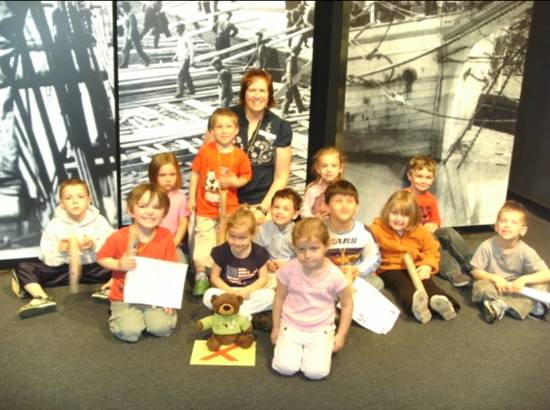
Sam and I also worked with a preschool class touring the museum.
We helped out by watching the “X” to mark the treasure at the end of their scavenger hunt and talking to the kids about keeping the ocean healthy and clean. I talked to the students about my travels around the world and Sam reminded the students “don’t trash where you splash”, one of his messages with the sanctuary system.
“Here we are at the end of the treasure hunt!”

Then we helped teach a 2nd grade class that visited the museum. Finally, I went to visit a group of 3rd graders in their classroom. There I helped the students to build models of the Great Lakes. Some of them even featured shipwrecks from the sanctuary! ….

Our visit has been a lot of fun while we’ve been in Thunder Bay and it’s great that Sam and I have been able to help spread the message about the oceans in a place that is still closely connected to them even though it is far away. Our trip into the Great Lakes has sure been a lot of fun for us. It was also a big surprise for me. Sam tells me we have another busy day ahead of us tomorrow, but bye for now! Ed.

Thursday, 15 April 2010

What causes ship wrecks?

Hi all.

After our tour of the Heritage Center yesterday we had a lot of questions. As you know I am fascinated by maritime history. So today, we set out to learn more from the sanctuary staff about the history of the ships in Thunder Bay.
“An etching of the sidewheel steamer New Orleans as it looked in the 1840’s.”


Last night we learned that there were a lot of ships that sank in Thunder Bay. Today Sam and I wanted to find out why. We learned that storms, heavy fog, unmarked shoals (that’s a fancy word for shallow water) and fires all caused shipwrecks. Sometimes mistakes made by the crew caused wrecks too. Many boats in Thunder Bay ran into each other just like cars do today! I guess the lakes must have been very busy for that to happen!
“The side of the New Orleans as it lies today in 10 feet of water”

The earliest shipwreck discovered in Thunder Bay happened in 1849. This ship was a side-wheel steamboat called the New Orleans. Her job was to carry passengers up and down Lake Huron. One day the boat got lost in a thick fog near Thunder Bay Island. Because the captain couldn’t see, the New Orleans got stuck in shallow water. Everyone on board was rescued by fisherman. Today people like to take boats and visit the wreck of the New Orleans. Here is a photo of what the shipwreck looks like. Boaters can easily find it because the sanctuary marks its location with a buoy.

Another shipwreck in Thunder Bay is the steamer Pewabic. Her story is a real mystery! In August, 1863, the Pewabic was headed south from the Upper Peninsula of Michigan. She was carrying passengers and copper. The weather was perfect! As she was about to pass another ship, the Meteor, she suddenly turned. Right in front of the other ship! The Meteor didn’t have time to react and crashed into the side of the Pewabic causing her to sink very quickly. To this day no one knows why the Pewabic turned.

This photomosaic shows what the Pewabic looks like today. A photomosaic is a large picture put together from many other pictures like a puzzle.

The New Orleans and the Pewabic are ships that sank a long time ago. I wanted to know if there were any ships that sank not so long ago! Sure enough, Steve had one - the Norrdmeer.


This was a ship that traveled all the way from Germany across the Atlantic Ocean to the Great Lakes. Her job was to bring steel to the United States. Just North of Thunder Bay Island she hit a shoal and sank in shallow water. Steve showed Sam and I some pictures of the Nordmeer long after she sank. Both of us were surprised to see a chunk of the boat sticking up out of the water! We were even more surprised to find out that the chunk stayed like that for over 40 years!

“The last remnant of the hull above the surface of the water last year, no longer there today.”
“The Nordmeer sits just below the surface of Lake Huron.”

Wow, these stories show just how important the oceans, rivers and lakes are for trtasporta nd ferrying goods. You might be surprised to know that many things are still transported in this way today. If you would like to learn more about the many shipwrecks contained in Thunder Bay National Marine Sanctuary visit their website at http://thunderbay.noaa.gov/

Bye for now! Ed.

Tuesday, 13 April 2010

Thunder Bay National Marine Sanctuary

Hi Everyone! Sam and I are no longer beside the sea. We have just arrived in a system of fresh water lakes in North America called the Great Lakes. Was I ever surprised that we were heading AWAY from the ocean to visit the Thunder Bay National Marine Sanctuary (which is in Alpena, Michigan!)

I had to ask Sanctuary Sam about why there would be a marine protected area in a lake, and he explained to me that the Great Lakes are actually the largest surface chain of fresh water anywhere in the world! The largest of these lakes is over 1,300 feet 9396 m) deep and altogether the lakes cover an area (94,250 square miles (242,000 sq. km), that’s almost as big as the surface area of the U.K.! This system of lakes is so big it contains 20% of the world’s fresh water (6,000 trillion gallons)! Wow that is amazing.
“Here is a picture of Sam and I entering the visitor center at Thunder Bay National Marine Sanctuary. Their exhibit is titled “Exploring the Shipwreck Century”

“Here is a map showing the Great Lakes and our location right now in Lake Huron”


Sam said that Thunder Bay National Marine Sanctuary is located on Lake Huron, one of the 5 Great Lakes. Here’s a picture of Sam and I looking at it right now. It was just like looking at the ocean it was so big.
It is certainly much bigger than any lake I’ve ever seen in my travels before. It’s no wonder they call these lakes “great”!


The cold, fresh water of these inland seas preserves wooden shipwrecks from long ago very well. Sam said that the wood on a shipwreck in the ocean is usually eaten by a mollusk called a Teredo (also called a shipworm), but since the Teredos can’t live in fresh water, even very old wooden shipwrecks in the Great Lakes are a lot like they were the day they sank. The waters of Thunder Bay contain some of the best preserved shipwrecks in the world because of the fresh water in Lake Huron. This means that archaeologists can explore shipwrecks that haven’t changed very much in over 100 years when they visit! As you know I am very interested in maritime history so I was keen to find out more.
This is a picture of a Thunder Bay shipwreck named the E.B. Allen. This boat was run into by another vessel in 1871 and is still nearly intact on the lake floor today.”


As you know I’ve already been to the Monitor National Marine Sanctuary which protects one very special shipwreck, but Sam said the region of Lake Huron that contains Thunder Bay National Marine Sanctuary holds nearly 200 shipwrecks, many still waiting to be discovered! He said that this is why there is a sanctuary placed here to help protect the many shipwrecks of the area from harm.
“Here is a map of all of the shipwrecks in the Lake Huron region where Thunder Bay is located.”


I was very excited to learn more about these shipwrecks, so Sam and I headed into the sanctuary’s visitors’ center to meet the staff. There I met Pat, the historian for the sanctuary. Pat explained to Sam and I that many types of boats have worked on the Great Lakes in the last 150 years. Thunder Bay National Marine Sanctuary contains an example of nearly every one of them in its 448 square-mile area. These shipwrecks are all preserved, protected and documented by the staff working at Thunder Bay and the data they gather has helped them to construct the special museum exhibit contained in the visitors’ center.

I was getting tired after my long trip from California, but the staff said that we should spend a few minutes in the exhibit before we turned in for the day. I’m glad we did because we learned some fascinating things and had a lot of fun! The staff showed us around their exhibit and took us on a tour of a 19th Century Great Lakes schooner recreated in their museum. We learned that this sailboat was built using the archaeological data gathered from a nearly intact schooner resting in 185 feet (56m) of water that wrecked way back in 1875!This huge sailboat model was made to show visitors what it would be like to be in a storm on the Great Lakes and it certainly was scary at first!

“Here are some pictures of Sam and I in the visitor’s center, a full-sized schooner was recreated in the exhibit. It’s very big, and Sam had to help as the lookout while I steered the boat.”

Next, Sam and I went on to explore what one of these schooners looks like shipwrecked on the lake bottom today. The discovery tubes let us see what it was like to scuba dive over one of these shipwrecks, and we didn’t even have to get wet! Sam said it made him really want to get into the water.
The staff promised us that we would get to see a real shipwreck up close underwater while we were in Thunder Bay. Now I have seen these exhibits I am even more excited than ever. A chance to explore a real wreck in my diving bubble.
Well, it’s been a big day for Sam and I and it is time we got off to bed!
“As a special treat I get to sleep in the Captain’s bed on the schooner, it will be a great night’s rest!”

Bye for now, Ed