Hi everyone,
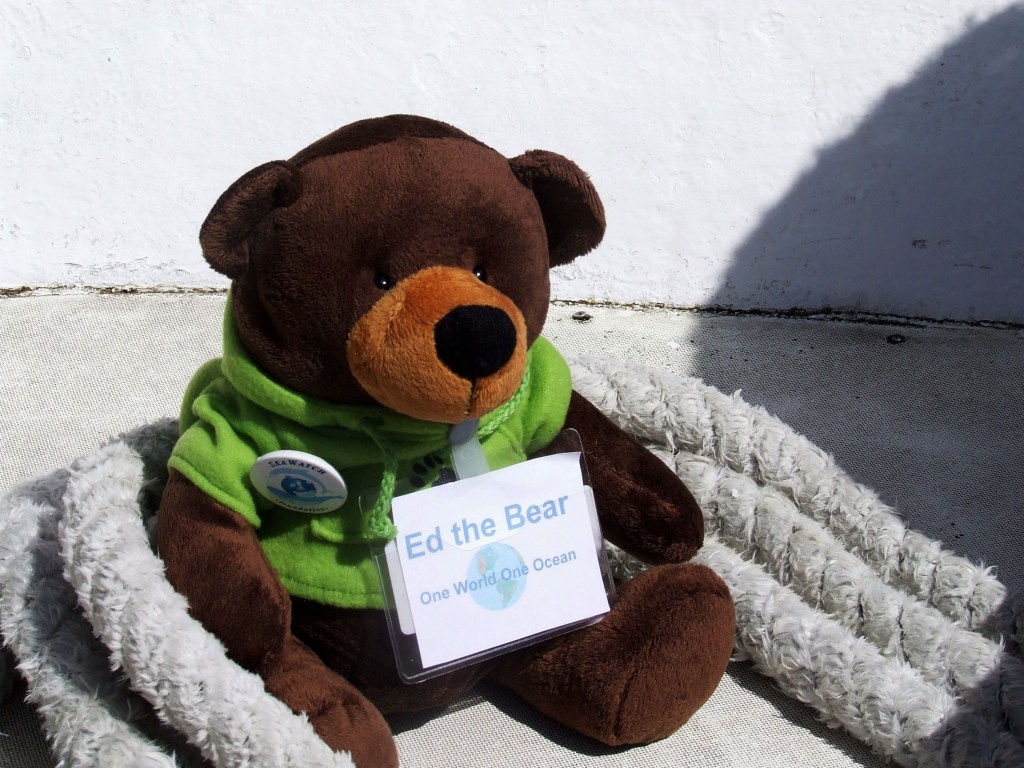
It’s me Ed, joined by Sanctuary Sam, about to begin an ocean adventure from Santa Barbara, along the coast of Southern California in the waters of the Santa Barbara Channel and a marine protected area, know as, the Channel Islands National Marine Sanctuary.
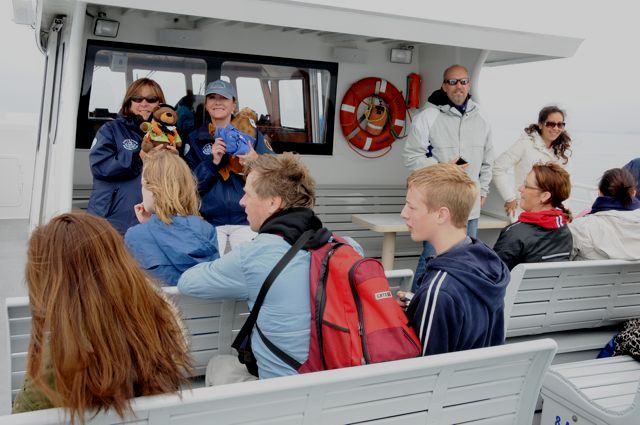
Today Sam and I will be joining volunteer naturalist from the Channel Islands Naturalist Corps (above) and the crew of the whale watch boat Condor Express (above) in search of marine life in the Channel and the Sanctuary.
Before the boat even leaves the dock we learned from the naturalist giving the passengers a pre-trip talk, there’s a possibility we might see whales today, which of course made Sam and I very happy! As we listen, he explains that whales are not just the large ones we often see pictures of and read about, like the Humpbacks and Blue Whales. There are also mid-size whales, like beaked whales, and smaller ones, like dolphin and porpoise, all of which are whales which scientist call cetaceans (si-ta’-shans).
As you know my buddy Steve studies our local dolphins and whales back in the UK.
The group of islands we’ll be traveling close to are, the Northern Channel Islands, sometimes referred to as the Galapagos of California. Not only will we be in the waters of the Channel Islands Natural Marine Sanctuary but we may travel through a corner of a Marine Protected Area (MPA). No fishing is allowed in the Marine Protect Areas, so the marine life will have the chance to increase in numbers in a protected healthy environment. Sam and I agreed that there should be more places like this.
(c) NOAA San Miguel one of the Channel Islands
(c) NOAA Santa Barbara one of the Channel Islands
We were told one of the reasons the Santa Barbara Channel is compared to the famous Galapagos is because a great variety of marine life lives in these waters. This is a transition zone, or separation area, where cold waters from the north and warmer southern waters mix in this partly enclosed basin, called a channel. It’s also a boundary area, where many marine species from the north and south meet, some overlapping.
WHY THESE WATERS ARE GOOD FOR WHALES
The captain talked about upwelling being common here, where seasonal winds move the warmer surface water away, with few nutrients, after which colder water, rich in nutrients, rises to the surface to take its place. This rising cold water contains many nutrients, including very small marine animals called, plankton. (You may remember I helped with some plankton studies at Monteray Bay). The krill, small shrimp like animals, feed on the plankton which are plentiful here in the late spring, summer and early fall. This is why such an abundance of marine life lives or comes to feed in these waters. Sam and I are really looking forward to going out to sea, because if there’s all this food in these waters, we should have a good chance to see lots of marine life.
RUBBISH
The boat backs away from the dock, moving out into the channel, we’re really getting excited. As it picks-up speed, we notice a little pitching and rolling, but we’re old hands at riding boats and we have our sea legs!
We go only a short distance when a naturalist sees a large cluster of balloons floating in the water. The captain slows the boat and turns to the right and a member of the crew moves quickly to get a boat hook, a long pole with a hook at the end. When the boat is close enough the crew member hooks the balloons, lifting them out of the water. The captain doesn’t say anything to the passengers, but Sam and I know getting trash out of the ocean is very important because fish and sea birds can mistake many types of trash for food and which could cause them serious injury or even death.
No sooner had we picked up speed than I noticed from the wheelhouse, where the captain steers the boat, something is splashing in the water and moving toward us. It’s kind of hard to see, so one of the naturalists picks me up and I now see everyone’s looking at a small pod of Common Dolphins.
Both Sam and I have seen Common Dolphin before, so we’re feeling pretty smart right now, but we’re not sure if they’re the long or short beak variety? They weren’t the only Dolphin’s we saw, a little later that day, we saw a small pod of Pacific While Sided Dolphins.
We also came very close to a raft of Sea Lions lying motionless at the surface, with there flipper in the air.
The captain tells all the passengers, this is called thermo-regulating, when they put their flippers, which have lots of blood vessels in them, into the air to either, warm or cool their bodies. Because the ocean water temperature is a chilly 55 degrees and it’s an overcast today, Sam and I are thinking, they’re trying to warm up?. As you might suspect Sam is pretty happy to see some of his kind, out here in the open ocean and sends a bark their way!
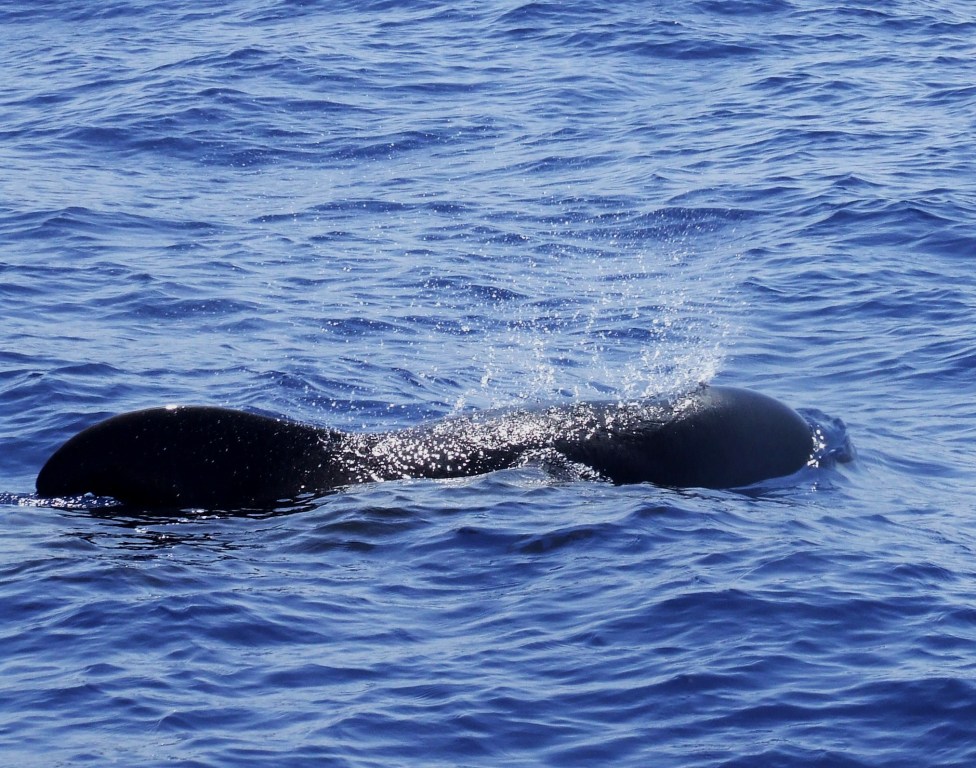
Soon after watching the Sea Lions, one of the crew members sees what he calls a spout, or blow (photo) which Sam and I have seen before, but mostly coming from small whales, like dolphins and porpoise, whose spouts are hard to see.
This blow looked to us like it could be coming from a bigger whale? The blow is a little bit like, when I go outside on a cold morning and I can see my breath in the air. It’s the warm air from inside my lungs meeting colder air outside. Basically, the same thing happens with whales! The whales makes their blow when they breathe out, which is called exhaling, for them, as well as Sam, myself and all mammals. There it is, I get my first close up look at the black back of a Humpback Whale swimming on the surface.
You may remember I saw some humpback whales in the distance when in the Hawaiian Islands.
The captain slows the boat down and skillfully turns it so we’re moving the same direction and speed as the whale. He’s very careful to keep his distance from the whale, which I already knew about, because it’s a regulation in Marine Mammal Protection Act, which we learned about on another trip. Whales can come close, to pay us a visit, but the whale watching boats has to keep its distance, being no closer than 100 yards away. The Humpback is moving closer and the captain says it’s a “friendly”!
We found out that nobody knows for sure if Humpbacks get their name because of the hump on their back, or because just before they dive they bend their bodies making a hump in the middle near their fin on their back, called a dorsal fin? Funny how things happen just as we’re talking about this the Humpback curls its body, raises its tail into the air, called flukes, into the air and silently slip beneath the surface.
The whale was close enough that we could see scars on its back and I asked one of the naturalist why it had so many scars? We were told Humpback’s sometimes fight with other males, so females Humpbacks will notice them. The scars are from old cuts, when barnacles on the flukes of a male, scratch the body of another.
In this specie of whale, know as a baleen whale, the female is usually larger than the male and can be as long as 50’ and weigh as much as 30-40 tons. Sam, a naturalist and I, all watch this Humpback close to us, when, out of the corner of my eye I see another Humpback has jumped almost entirely out of the water turns slightly and comes crashing down with a giant splash.
Wow, that was really exciting
I tell the naturalist I’ve heard of this whale behavior before, it’s called breaching. Sam is looking off in the distances and sees another Humpback doing a special movements. The captain calls movement a pec (pectoral) fin slaps
and another whale is side rolling and we notice one Humpback lifts a pectoral fin in the air and hold it there for a few seconds, like its waving to us, so I decide to wave back.
Passengers are saying, uuh and ayah, and cheering these acrobatic movements and I must say it’s very amazing!
Wow! Sam and I are getting pretty good at noticing blows and while I’m watching a blow in another direction a Humpback surfaces right next to boat and I can tell it’s a female, which I know because, it quite large and she has almost no scars on her body. This time I could see bumps on top of her head. These little bumps are places where individual hairs comes out of her head. One of our naturalist friends explains that Sam and I, just like whales, are mammals, have hair or fur, breath air, are warm blooded, give birth to live young and give milk to their babies.
I never expected to be so close to these giant animals. It made my hair stand on end and it gave me a feeling of just how special these animals are and how much they depend on all of us, to take good care of the oceans, so they can increase their numbers and live a long life.
As we move even further West, I noticed a spouts coming from whales all around the boat, but one I’m looking at seems taller than the rest. The captain and crew are noticeably excited and the Condor Express begins to move toward the spout I’d just been looking at, to the right side of the boat. I’m pretty proud that I was the first to notice this spout, which is now directly in front of us. Someone said it’s at 12 o’clock, which a member of the Condor Express’s crew explains is like looking down at the hands of a wristwatch. When both hands are together at the twelve, it’s 12 o’clock, or what would be the bow or front of the boat, when giving directions. When the big hand, or minute hand, is pointing to 12, the small hand on 3, the whale would be directly off the right side If it’s at ……………… Hey, I’m no rookie any more, I know how this works, as I stand a little taller, feeling proud of myself.

The captain’s voice blares over the loud speaker saying he’s positive he’s seeing a Blue Whale and mentions they’re the largest animal to ever live on the planet, even larger than the biggest dinosaurs. He says it looks like an adult and could be as long as 85’ and weight more than our boat and all the passengers, as much as 100 tons. One of the other captains, there are two aboard, now at the wheel, tells us the Blue Whale, while the largest critter, in the world, eats some of the smallest animals in the ocean, called krill which I know about, because I have been listening carefully and making notes. There are millions of them just in the area around the ship, imagine how many there must be in all the world oceans?
Our new captain is looking at the krill below the boat on his sonar, which is a special electronic device that sends sounds waves to the bottom. In this case the sound waves are bouncing off the krill. He lets Sam and I take a look at his screen, which like a computer screen. At 300’ below the boat, a light green colored band or line appears on his screen. That’s how he knows the depth at which the large whale, while the largest critter, in the world, eats some of the smallest animals in the ocean, called krill which I know about, because I have been listening carefully and making notes. There are millions of them just in the area around the ship, imagine how many there must be in all the world oceans? Our new captain is looking at the krill below the boat on his sonar, which is a special electronic device that sends sounds waves to the bottom. In this case the sound waves are bouncing off the krill. He lets Sam and I take a look at his screen, which like a computer screen. At 300’ below the boat, a light green colored band or line appears on his screen. That’s how he knows the depth at which the large school of krill are swimming at.
He says, this means we probably won’t see any Blue’s feeding on the surface today, which happens when the krill are near the surface. While it’s overcast today, and krill are more likely to be on, or near, the surface in low light conditions, that isn’t the case today.
The relief captain says Blue Whales need thousands of calories everyday during their feeding season, which here in the Santa Barbara Channel, can be as long as from four or five months, from June to October. Because of the upwelling, which we already talked about, there are millions of krill here and its one of the best places to see Blue Whales year after year, anywhere in the world. According to the captain, there are only 10,000 Blue Whales left in the world and there were estimated to be as many as 350,000, before the days of whaling began. Did you know some people hunted whales before they were protected?

Sam and I have heard about endangered species before this trip, but I didn’t know the Blue Whale was one of them and so few of them remain! It definitely makes me sad, but when I return home I’m going to tell all the children I visit, the teachers and other people, how important it is to protect these beautiful animals. The captain says, the good news is, they’re making a slow recovery!
We watched these two giants for almost an hour swimming, diving, swimming on their sides and perhaps even eating krill, although it was hard to see if that was happening today? Lucky for Sam and I, we were able to watch all his from the fly bridge where we had a good view.
Not only did we have a better view of the whales, we were able to overhear the captain, a crew member and a naturalist talking about some problems the Blue Whales are having. I didn’t know about some of the them, so my ears perked up and they mentioned about how big ships, like the container ship we’d seen earlier today, just two years ago had accidentally hit a Blue Whale and it died. From what they were saying, I guess this happened several other times that season and they think most of these Blues died from these ship strikes.
Another problem is, it seems Blue Whales only eat one kind of food, and that’s krill, the tiny shrimp like animals. I guess in some places, like the Antarctic they’re netting them and drying them out and making a protein powder being used as a food supplement.
I couldn’t hear everything but it sounded like they said, if krill are over-fished, it could make it hard for Blue Whales to get enough to eat to be healthy to make a comeback.
The naturalist on the fly bridge says the difficult part about this is, Blue Whales only eat one kind of food the ocean provides which is krill. This is different from the Humpback Whale we saw earlier, who eats krill, sardines, anchovies sardines red crabs, squid in fact, any ocean animals they can “schools up” to form bait balls, so they can eat hundred or thousands in one gulp.
All this talk about problems the Blue Whales face was hard to hear. It made Sam and I think that all of us need to do our part to make sure our oceans and the marine life in it is an important issue that one of us forget!
I must have looked kind of sad or just thinking about what they were talking about, but the naturalist on the fly bridge turned to me and said it was to bad some of these things taking place but if we all do our part , we can make a difference, healing the ocean increasing its abundance so all marine animals are healthy and abundant.
Sam and I feel energized and are ready to talk to our friends, write letter and send emails, especially to those who make decisions about the oceans and all its special animals. One of the naturalist says she likes the saying: Think globally, act locally, because there’s so much we can do at home, right in our own towns.
While we were talking to the crew and naturalist the Condor Express has been heading back to Santa Barbara and both Sam and I feel very lucky to have spent the day on the with the crew and naturalist and to learned about marine life in the Santa Barbara Channel and at Channel Islands National Marine Sanctuary and especially to see so many large marine mammals.
As the boat pulls up to the dock we say good-bye to the crew, people we met during the day and to the naturalist for taking us along and for all information they shared with us!. We know they love what they do, as much as we do!
All three naturalist gave Sam and I each a hug and we all hope we can see each other again!
For Sam and I, while it’s the end of this trip, we’ll continue to explore other oceans of the world, to enjoy their beauty and learn how all of us, as citizens of the world, can work together to, identify problems in our marine environment, make everyone of aware of changes taking place, and how we can all help to correct them.
All this fresh sea air has made me hungry and a little tired. I think I will have a snack and a little nap
Bye for now, Ed and Sam