Showing posts with label USA. Show all posts

Monday, 15 March 2010

Gulf of the Farallones National Marine Sanctuary

Sanctuary Sam and I arrived at the Gulf of the Farallones National Marine Sanctuary offices in San Francisco, California today. This is quite near to the Cordell Banks Sanctuary offices I visited earlier this year. I’ve heard San Francisco is famous for its fog, and it was very dull when I came last, but today it was a beautiful, sunny day, and the Golden Gate Bridge, near the sanctuary offices, glowed a bright orangey-red – not golden at all!


Unlike the offshore Cordell Bank sanctuary, the Farallones sanctuary is right next to San Francisco where about 8 million people live. Lots of people, and lots of wildlife, all living side by side. The Farallones sanctuary protects the waters outside the Golden Gate Bridge and around the Farallon Islands, which are about 27 miles offshore. It also includes some shallow coastal areas, called estuaries, like Tomales Bay, and Bolinas Lagoon.
In this map you can see Gulf of the Farallones National Marine Sanctuary where I am now, the Cordell Banks Sanktuary where I visited before and Moneray Bay (my next destination)

But for now there So much to discover here! First we learned about the local wildlife with a Visitor Center tour. The visitors centre has life-sized replicas of white sharks and giant elephant seals.
I'm glad this great white shark is only a model. I know humans are not their usual prey but a little bear like me could easily be mistaken for a tasty morsel. My buddy Steve, back in the UK, teaches people about sharks and he has written books about sharks as well. Steve also has a seal shaped decoy which has been chewed up by great white sharks that the kids can handle.

The enormous elephant seal replicas were fabulous, and we even listened to recorded whale voices – something Sam has experienced before while actually swimming in the ocean with them! Awesome sounds!

The aquariums have big green and tiny pink anemones. They are so huge they look even more like plants.
 I was so surprised when I first discovered that sea anemones were actually animals. In another aquarium tank there was a monkeyface prickleback eel named Monty, some crabs, and a big abalone.

I learned that this part of the Pacific Ocean is one of the four most productive areas in the world because of something called “upwelling.” Along the coast here, strong springtime winds push the surface waters offshore and that brings cold water, which has lots of nutrients in it, up to the surface. Near the surface, the combination of nutrients and sunlight allows the tiny one-celled plants, called phytoplankton, to grow really fast – just like a garden that’s been fertilized. Lots of different kinds of animals eat this plankton, including little shrimp-like animals called krill. Krill is a very important food, and there’s so much of it here, giant blue whales come here in the summer to feed on and can eat up to four tons of it each day!

But many other kinds of animals live here, too: 36 species of marine mammals (like Sam’s buddies, the California sea lions, seals, sea otters, porpoises and dolphins), and thousands of different fish, birds and invertebrates – sea snails, limpets, sea stars and sea urchins. In fact, there is so much food here, that many animals travel thousands of miles just to come here and feed, including seabirds and even sea turtles. One bird, the Black-footed Albatross, flies here from Hawaii to get food to bring back for its chicks. It takes the bird three weeks to make the trip here and back – that is a really long way to go for a grocery run!

Black footed albatross

The Farallon Islands, a very rocky and jagged group of rocks, aren’t actually part of the sanctuary, but are a National Wildlife Reserve where hundreds of thousands of seabirds nest, and five types of seals and sea lions come ashore to rest or have their pups (babies).


There are no schools or shops on the islands, not even a dock: to get on the island, a crane lifts people and supplies from a boat onto ledge. That must be exciting – and maybe just a bit scary. Only a few scientists can live on the island at a time, to make sure the wildlife won’t be disturbed.

The Sanctuary Visitor Center exhibits gave us just a sneak preview of different animals and habitats of the sanctuary. We got to get an up-close look at some these animals in the visitors centre aquariums, and found some of the same creatures under the dock and among the rocks and sand on the beach outside the visitors centre. We are hoping to encounter even more of them out in the wild during the rest of our visit.

All the animals - the tiniest krill, the birds, seals, fish, whales and even sharks that feed in the sanctuary waters around the islands, and the humans that fish or swim in these waters need a clean, healthy ocean to survive. And that’s why this area is a sanctuary – because things like ocean dumping and oil drilling that would pollute the water, or disturbing wildlife are not allowed. It’s good for them, and good for us.

Tuesday, 9 March 2010

More from the Mokupapapa Discovery Center

Aloha

I’ve had a great time hanging out with everyone here at Mokupapapa. They showed me all around the exhibits that showed off all sorts of amazing animals you find up in the Monument.
I even got to meet a Laysan Albatross. I’ve been wearing this tag from Fred the Monkey for a long time now, and this was the first time I got to see one close up. (Hmm, I wonder what my buddy Fred is up to?)
(c) NOAA

Their wings stretch over five feet across! (over 1.5 metres). That’s so they can soar for thousands of miles all around the Pacific Ocean. I asked him if he knew x360, but he said he hadn’t known him.

It seems like there are some well travelled animals here in Hawaii. I also met a green sea turtle who explained that he was born 500 miles away, like most green sea turtles, in the Monument.
He said his family and all of the other families he knows all do that - swim all that way to give birth, and then come back to one of the Main Hawaiian Islands the rest of the time.

(c) NOAA Newly hatched green turtle makes for the safety of the ocean.

(c) NOAA Adult green sea turtle

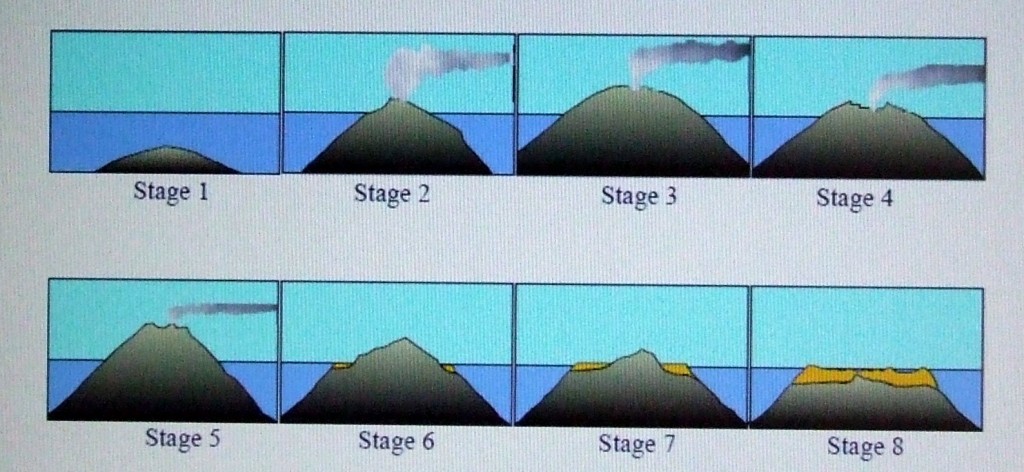
The real star of the Monument is the coral polyp.

I sat in on a lesson that Tanya was giving to some local children about polyps and finally started to understand how the coral fits into the picture of the life of an island. The coral keeps growing around the islands, even as the islands erode away.

(c) NOAA .The coral is shown as yellow

After awhile, all that is left is coral and the rock is under the water. But that’s okay, because the coral reefs create homes for all sorts of ocean critters.
(c) NOAA

The reefs also help form sandy islands – like the one that the green sea turtle was born on. And it all starts with a tiny coral polyp – small but mighty!

I’ve had a great time here, but Sam says I still have all sorts of cool places to visit, and we need to get going. Aloha Hawaii!

Monday, 8 February 2010

Deepsea Corals and Acid Oceans

Hi all

You may remember that I looked around the discovery Centre yesterday and learned some amazing facts about deepsea habitats and deepsea corals. Well today, Sam and Hannah took me to meet another Ed! Ed Bowlby the research coordinator at Olympic Coast National Marine Sanctuary (OCNMS).

Ed. B is one of the lead researchers on the deep sea coral cruise.

Ed. B explained that deep sea corals are very sensitive animals. Yes- Animals! Corals look like plants, and they don’t move around like most animals, but they are animals. Individual coral animals are called polyps. Corals are at risk around the world from changes that are happening to the ocean.

Ed. B said that researchers have learned that carbon dioxide in the atmosphere reacts with seawater and lowers the ocean’s pH, making the ocean more acidic. This phenomenon is called ocean acidification. You may remeber when I was at Spokane Community College last year with Methea, I learned a bit about pH and acidic oceans while helping Methea with maintenace of their 180 gallon marine invertebrate tank.

Ed. B explained that as the ocean becomes more acidic it may dissolve the outer skeletons of animals like corals faster than they can build a new skeleton. It can also weaken the shells of mussels, clams and oysters. He said that there are still so many things we do not know about ocean acidification and what it may do to animals that rely on the food chain (what they eat) that may be hurt.

I thought this all sounded really scary!.

Afterwards, Ed. B introduced me to some of the other OCNMS staff, too.

Find out more about my stay at OCNMS very soon.

Bye for now, Ed and Sam

Friday, 5 February 2010

Ed visits the Discovery Centre at the Olympic Coast National Marine Sanctuary

Hi all

Well, we have both arrived safely at our next destination, the Olympic Coast National Marine Sanctuary.

Sam showed me around the discovery centre which he said is the best place to start, because there is so much to see. The sanctuary includes a very big piece of coastline. In fact 135 miles of beautiful shoreline with very little human buildings and has more than 48 miles of wilderness beaches – un-spoilt and natural. This area is very different to my coastline back home which has many houses, a harbour and industrial development.
And guess what, the Olympic coast sanctuary also includes the ocean to about 35 miles from the shoreline. The coastline here is home to 29 species of marine mammals, hundreds of species of birds, and thousands of species of fishes. My buddy Steve will be so jealous. Sam also introduced me to Hannah, who told me that Native American peoples - the Hoh, Makah, Quileute and Quinault - have lived along this coast for thousands of years and continue to do so today. When I was with Ron I had the chance to meet some of the S’Klallam in Port Gamble. I hope I get the chance to meet these fascinating native people who lives are entwined with this amazing coastline.

I saw a huge 3-D map showing the Olympic Coast National Marine Sanctuary boundaries. Sam told me that Olympic Coast National Marine Sanctuary has three underwater canyons – Nitinat, Juan de Fuca, and Quinault. These underwater canyons are steep-sided valleys on the seafloor. Sam told me that the lighter blue areas on the map showed the shallower continental shelf close to land and the dark blue, sunken-in areas were the deeper ocean areas.

Sam explained that deep water is very different to shallow water near the surface. This is because deep water is colder, has less light, less oxygen, and more pressure. The deeper you dive the more water is above you. The weight of this water pushing down is what we call pressure. Animals that live near the surface would be crushed by the pressure if they dived too deep. Some animals have adapted to live in deepwater with this pressure, but would die if they came to the surface. 10m below the surface and the pressure is 2 times greater than at the surface. At 1000m the pressure would be 100 times greater than at the surface. Humans would need a submersible (mini-submarine) to reach that depth and only a few whales can dive that far down. Sam said he was a very good swimmer but 1000m was far too deep for him to dive.

So the animals that live in the deep water habitats are quite different to those that love near the surface. In the deep water off the Olympic coasts live deep sea corals, usually at depths between 80m and 1000m. They are different than tropical reef corals found in shallower, warmer waters in the tropics, such as the corals I saw in the sea around Kauai.

Most tropical reef corals have algae called zooxanthellae that live in their cells. The algae take energy from the sun and convert it into food for the corals. Deep sea corals do not have these algae because there is no sunlight in the ocean depths. They have to rely on stinging tentacles to catch their food.

In the sanctuary the deep sea corals live in the Juan de Fuca Canyon. I learned that even though corals may look like plants, they are really animals related to jelly fish. Sam and I investigated the coral Lophelia under a large magnifying glass!

Next, Sam showed me the exhibit of Paragorgia. Although the coral has one hard skeleton, I can see many individuals coral animals (called polyps) that live in the skeleton. These white polyps live in a colony. While the whole colony can grow to one metre tall each individual polyp is usually less than a centimetre!
Primnoa was the last coral I saw in the Discovery Centre. This exhibit showed how corals provide habitat for many other animals. The display said that these rockfish live amongst the corals, but other animals like invertebrates (animals without backbones) are also found among corals.
Scientists use submersibles (crafts that go underwater) for deep sea research. While no one was looking me and Sam climbed up on top this submersible for a closer look.
This is called the Deep Sea worker and is a one-man submersible. The Deep Sea worker is great for taking photos or making observations, but a machine like the ROPOS (Remotely Operated Platform of Science) is better for deep sea coral research.

The ROPOS is not as dangerous as a manned submersible. Researchers do not need to be inside the ROPOS to operate it. Instead, the ROPOS is attached by a cable to computers on a ship above the water. This means the submersible can help with research, while the people are a safe distance away.

Wow, I have found out lots of stuff about the Olympic Coast. I hope I will be able to see some of these things for myself while I am here.

Bye for now, Ed and Sam

Tuesday, 2 February 2010

Ed on the radio!

Hi all

Today I got to sit in as a very special guest on KWMR (www.kwmr.org), community radio for West Marin, the hometown of the offices of Cordell Bank National Marine Sanctuary. Jennifer hosts a monthly radio program all about the ocean.

I got to sit in the studio and listen in to an interview with the West Coat National Marine Sanctuaries Regional Director, Bill Douros. He talked about how coastal managers have to consider the land/sea connection when making management decisions about the ocean. Bill discussed how it is important to  consider how the coastal ecosystem is intertwined with many things such as habitats, and peoples work. It is also important to consider the various functions that the ecosystem serves.


My buddy Steve, back in England, is on the management group for the Shoreham Beach Local Nature Reserve, which is also my local beach. The management group has to consider not just the rare vegetated shingle habitat, but also the needs and possible impact of local residents and beach users. This also includes recreational use of the beach and the inshore waters, such as fishing and kite surfers. The management group must also consider impact from issues such as climate change and marine litter.

I also got to hear about the San Francisco Ocean Film Festival that is coming up. What fun, an entire film festival about the ocean! You can find out more by following the link below.


You can hear Bills interview by visiting this website


It may not be available straight away, if not try the link again in a few days.

You can also hear past shows from all sorts of ocean topics from deep water exploration, to a woman who has been rowing across the Pacific Ocean in a rowboat, Roz Savage (Roz is from the UK).

I learned that it would be better to come back to Cordell Banks in the fall months (We call it Autumn back in England). In the fall the weather typically calms down on the ocean and humpback and blue whales can be seen in the sanctuary waters. That would be great to see.

It was great here and its a shame I must leave already. I'm heading off for my next destination, the Olympic Coast National Marine Sanctuary tommorow! I wonder why its called the Olympic Coast?

Bye for now, Ed

Wednesday, 27 January 2010

Earthquakes, safety at sea and studying oceans

Hi all

I found out today that it’s not just the oceans that are very complex, the whole planet is. While the earth surface seems to be solid to us the earth’s surface is actually made up of separate pieces which are called plates. They all fit together a bit like a jig-saw puzzle. These plates are constantly moving, but very slowly. In fact in a year the plates will only have moved a few centimeters. The places where these plates fit together are called fault lines. These are also places where earthquakes can occur. This is quite a difficult topic to cover in my blog so if you want to find out more about these plates and fault lines you can check out the web link below.
http://www.moorlandschool.co.uk/earth/tectonic.htm

The reason I mention this is because I found out that California has a major fault line. I discovered this was called the San Andreas fault, which is a fault that runs throughout California and is famous for causing the 1906 earthquake that nearly devastated the city of San Francisco. There are many fault lines in the Bay Area that are active and produce quakes. Jennifer, one of the education people here at Cordell Bank National Marine Sanctuary took me and Sam to see where part of the fault line is. Although you can see the fault lines marked on maps, you can’t see the actual fault line in real life. However, Jennifer showed me the blue poles that mark where the fault line runs.
I was interested to hear that the San Andreas fault separates the continental plate from the Pacific plate, so I could not resist hopping between plates over the fault line and back again!

Unfortunately I was unable to visit Cordell Bank itself, as its 20 miles offshore and the ocean is quite wild here in the winter time. There has been a powerful storm in the area for sometime so the seas have been quite unsafe for me to visit, so instead the staff at Cordell Bank showed me some of the stuff they use to learn about the waters at Cordell Bank National Marine Sanctuary.

Jennifer showed me a special coat called a “float coat”. They don’t come in small bear sizes so I tried on a human sized one which as you can see is a little big for me, but it was still warm and toasty!

These coats have built in flotation for researchers on a boat, so they can be safe and stay warm too. If they do accidentally fall in the water the coat will keep them afloat. Its water proof as well! Sam said the air temperatures out on the Pacific can be quite chilly even during the summer months, so if you don’t have fur like me, layering clothes for warmth is important.

Check out this crazy instrument. This is a CTD, instrument which stands for Conductivity, Temperature, and Depth. The frame houses special sensors which records information about the surrounding water. The instrument is lowered to just above the seafloor and collects data the whole way down to help scientists understand what the water column is like. A water column is an imaginary area of water (column shaped) from surface of the ocean down to the seabed. Apparently when they do this test near shore outside of San Francisco, they can detect the fresh water that runs out of the San Francisco Bay, whereas farther offshore and north away from the bay, there is much less fresh water to be detected.
The staff here also have a special submersible (like a miniature submarine) to help the research team use to help them monitor and explore the seafloor habitats of Cordell Bank.

They gave me a controlled model one for me to see. Of course this one is even too small for me, but you get the idea. In an area like this, where the habitats are too deep to SCUBA dive in, this is a great way to learn about this sanctuary.

Bye for now, Ed

Tuesday, 26 January 2010

Ed the Bear arrives in California

Hi all

Wow, I made it all the way across the country from the east coast and have landed in San Francisco, California. Some of my buddy Steve’s family live in California, but I hear California is a big place so I guess I won't get to see them. I know Steve's cousin Geoff has a child called Sabrina who is really interested in the ocean as well. Hi Sabrina if you are reading this message.

I did not realise just how far it was from one side of the US to the other. It's about 3,000 miles from the east coast to the west coast of the US. I’m glad I didn’t have to walk. California looks quite different to Virginia on the east coast so luckily Sanctuary Sam is from this region and has been pointing out all the amazing things to know about this incredible part of the world. First, I saw the Pacific Ocean which is big! Sam, saw a few of his buddies who started barking at us from the water, as Sam is a California Sea Lion. As you know Sam is now an ambassador for the sanctuaries.


As you can see in this picture, we are in front of the world famous Golden Gate Bridge that crosses San Francisco to Marin County California. The River Adur back home in England is very small compared to this great body of water. We have a small bridge crossing the river, but the Golden Gate Bridge is enormous. It’s hard to imagine how they even managed to build it across the bay especially as the total length of the bridge spans 1.2 miles. The area under the bridge drains approximately 40% of California’s water from the Sierra Nevada mountains to Sacramento and San Joaquin rivers to San Francisco Bay and out to the ocean, which has 3 neighboring National Marine Sanctuaries outside it.

The waters outside the Golden Gate are so productive with marine life that 3 Sanctuaries are here and I will get to visit all 3 of them. To the south is Monterey Bay National Marine Sanctuary, where I hope to see a sea otter and learn about kelp forests and the deep sea Monterey Canyon. Right outside the Golden Gate is the Gulf of the Farallones, where apparently there are quite a few big white sharks, they tell me I am just too small to be a prey item for a white shark, so not to worry.

Back in England I helped Steve run a course on sharks, so hopefully I might see one while I am here. And just north of that is Cordell Bank NMS, where an underwater mountain is thriving with amazing colorful invertebrates and fishes. This whole region is known to attract animals all the way across and around the Pacific to feed here because there is so much food in the water. Whales, seabirds, and elephant seals, and more thrive in these cold, food rich waters.

A really wet and intense storm has been in the area for a few days, bringing huge amounts of rain to the area. While residents are happy for the rain as the state has been in a draught, I witnessed large amounts of plastic and styrofoam bits washing up on the beaches as a result.

These items were probably washed into the ocean upstream somewhere and the huge wash of water brought it here. This is a lesson that we can all work harder on to prevent, by making sure we leave nothing on the ground and pick up litter whenever we see it, so it doesn’t wash into the ocean and get eaten by ocean animals. You may remember that when I was visiting Methea at Spokane Community College, (in Washington State, the next state up) she told me about the problem of chemicals and litter being washed into rivers and flowing down stream into the oceans. Now I have seen it for myself.

Bye for now Ed and Sam

Tuesday, 12 January 2010

Ed discovers why Chesapeake Bay is polluted.

Hi all

Today, I asked Sanctuary Sam to tell me more about the pollution problems in Chesapeake Bay. You may remember from my last message that Chesapeake Bay is where the USS Monitor fought its famous battle. There was a picture of it in my last message, where Sam and I were standing by the sign; there were lots of ships in the pictures too.


Chesapeake Bay

Sam was telling about all the wonderful sea creatures that live in the bay such as oysters, blue crabs, and different kinds of fish. Sam said sometimes it is hard for them to breathe in the water. Breathe?! Did you know that underwater animals breathe? Well, they all need oxygen to survive just like us, but they have gills instead of lungs. I remembered that the aquarium tank at Spokane Community College had pumps and filters to circulate the water and keep it healthy.


Blue Crab

As you know, I have helped with a lot of beach litter clean up but Sam told me that a lot of the pollution in the Chesapeake Bay is stuff that you can’t see. So, even though sometimes you can see stuff floating on top of the water, it is the invisible pollutants that run off the land and into the water that have made the bay so sick.

I asked Sam what are pollutants and he said that they are chemicals and substances (often poisonous) that can come from a lot of different sources. These sources could be fertilizers from farms and our yards (this is what we call gardens in England) or chemicals from industrial plants. Methea told me about this when I was helping out at the Community College in Spokane. We watched the snow melt and run into the river, which would flow down to the ocean. Methea said that chemicals from the land can also get washed into rivers and down to the sea where they could be very harmful. Sam said this is what can happen when the chemical pollutants find their way down into the ocean.

Sam told me that some of these pollutants actually make a lot of algae grow in the water. When the algae dies and sinks to the bottom of the bay, it uses up a lot of oxygen as it decomposes. The more algae that dies, the less oxygen there is in the water for the other animals. This creates something called a ‘Dead Zone’ which is an area where almost none of the underwater animals can live! I wonder if there are any dead zones in the water around England.

Sam did tell me that there is good news for the Chesapeake Bay! There are many organizations that are trying to make the bay healthy again by reducing pollution. Also, President Obama announced that the Chesapeake Bay is so important that it is the United States Government’s job to help clean it up! The bay is slowly getting cleaner and I hope that the next time I come back the water in the Bay will be much healthier.

Bye for now, Ed

Sunday, 20 December 2009

More from Spokane

Hi
Today Methea showed me some of the specimens that she uses to teach her kids about the oceans. Here I am taking a closer look.


These are preserved specimens including crab, shrimp and sea anemone.

This great horned eagle owl died after being hit by a car. It was preserved so that people could see what an owl looks like up close.


Methea said that the great horned eagle owl is one of the regions largest birds of prey. I did not tell Methea that I thought the owl was a bit scary. I don't think I would have turned my back on a live one!

I have had a really great time here with Methea and I have learned a lot about the oceans too. I hope I will be invited back again in the future, hopefully next time I will get to meet the kids too. A big thank you to Methea for looking after me so well.

Oh well, off to bed as tomorrow I will be taking a detour and travelling back to England to tell the people back home about the amazing things I have seen so far. Having seen all the harm that marine litter, especially plastics are doing to the oceans, I feel I need to get back to the UK to pass on this message - including Fred the Monkey's Plastic Free Friday decaration. See my blog entry 25th October 2009 if you missed it. It is a very important message following my work with Fred the Monkey and Ron Hirschi throughout October and November.

I learned a lot from Fred the Monkey and his buddy Ron Hirschi as well. I do miss Fred, I had a great time with him during my visit. Hopefully we will meet up again some time in the future. Fred has been a very busy monkey since we meet. You can find out more about what Fred the Monkey has been doing to save the oceans wildlife from plastic litter by going to project Soar http://soaronhirschi.blogspot.com/
or by clicking the link on the side panel of this blog.

Christmas is a great time for humans and bears, but the festive season also generates a lot of litter and I need to pass on Fred and my message of Kuleana, Hawaiian word meaning responsibility.

Bye for Now
Ed  zzzzzzzzzzzzzzzzzzzzzzzzzzzzzz

Sunday, 25 October 2009

Plastic Free Friday

Hi all

While Prime Minister Gordon Brown meets to discuss global issues with other countries, Fred the monkey has organised a meeting with representatives from different animal "nations" to find a way that we can protect animal life from death by plastic. Fred told me he has been in contact with president Obama. He said the president wants Fred to talk story with as many animals as possible, getting the unbiased accounts of the earth's environmental problems.

The meeting included myself, Shark from the Open Ocean, Humuhumu from the Big Island, Monk Seal from Kauai, and Fred's buddy Redfooted Booby who snuck back with Fred from Pihemanu out at Papahanaumokuakea, we decided to do this for our friends the Albatrosses.....


As you can see in this photo at our high level meeting at the beach, Fred is wearing still more leg bands from albatrosses who died young due to markers, toothbrushes, toys, bottle caps, lighters, water bottles, and other plastic entering the sea daily by the tons. The result of our meeting, PLASTIC FREE FRIDAYS which is our way of saying no to plastics.
We ask you to avoid buying any drink in plastic bottles, any food wrapped in plastic, and any toy or other thing you might use made from plastic this, and every Friday.

You can find out more about Fred and this declaration of PLASTIC FREE FRIDAYS on his own weblog http://soaronhirschi.blogspot.com/
Check it out and see what you can do to promote plastic free Fridays and find out what else Fred has been up to.

Bye for now

Ed