Showing posts with label Shoreham Beach. Show all posts

Saturday, 23 June 2018

Exploring our local coast with school

A week of working with schools visiting the nature reserve.

We have changed location this year due to the river flood defence which is still going on at our usual rock pool beach.
This is part of river flood defence that should protect Shoreham for the next 100 years.


So instead we collected a few sea creatures each morning from another local beach (but suitable for school visits) and set them up on tables for the children to have a close up view and learn about during our presentation and Q&A


 We found some fascinating rock pool life including goby fish and this camouflaged blenny


We also found this live oyster attached to a rock. The juvenile oyster settles on a rock and glues itself on and the shell grows out like a shelf.


There were also lots of juvenile shore crabs.
Their colour matches their surroundings when they are young, but when fully grow have their adult colours, green on top and orange underneath.
Afterwards, the children explored the shingle beach, learning about the rare vegetated shingle habitat, the seashore strandline and also learned about plastic pollution during a litter pick.


Well done to all the schools we worked with this week, you did some amazing work.


All best, Ed the Bear.


Wednesday, 13 June 2018

World Ocean Day Message 3

Back in September 2009 I started my global travel to find out more about how Shoreham Beach Local Nature Reserve was connected to the global ocean.

As you know Shoreham Beach has a rare habitat called vegetated shingle, which grown just above the high tide line.
We were concerned about how global threats such as climate change and global warming might damage the shingle beach.

To understand how this might happen we decided we needed to understand more about the global ocean and that's were my journey began.

I visited many scientists and experts to learn about the ocean, including NOAA who built me my amazing underwater dive bubble.
 
 
I learned how Shoreham Beach was threatened by sea level rise which could flood the rare plant habitat or create bigger storms that could wash the beach away.

I also discovered that sea level can cause flooding from rivers too.
The environment agency are currently building a new flood defence wall along the river which should protect the town, the airport and surrounding land for the next 100 years.

I have also encountered amazing wildlife on my travels to, from penguins in Antarctica to coral reefs of Florida and great white sharks off the coast of South Africa

Follow my amazing adventures on this blog. You can also find out more about the One Ocean Project and how we can help the ocean at  http://seawatch17.wixsite.com/one-world-one-ocean

Friday, 9 June 2017

World Oceans Day


Hi all
Due to important river defences work on the River Adur to avoid future flooding of the town, this year’s Adur World Oceans day did not take place on Coronation Green. This would have been the 18th year this popular event has taken place at Shoreham. World Oceans Day 8th June, is a global opportunity to raise awareness of the challenges faced by the international community in connection with the oceans. Around the word, a week of events to celebrate the ocean have been taking place.
To help mark World Oceans Day we sent an article to our local paper raising awareness of Ed the Bears global travels as  well as the local consequences to sea level rise.

In fact, the consequences of rising sea levels is the main reason the Adur World Ocean Day event did not take place this year. We often think of melting ice caps as being the only cause of sea level side, but actually half of sea level rise so far has been due to the oceans getting warmer – as water warms it expands and when this happens on an ocean wide scale that’s a lot of extra water”.

Sunday, 14 February 2016

Ed and Bella Bear at the Brighton Science Festival


Yesterday, Ed and Bella Bear took part again in the Brighton Science Festival again this year as part of the One World One Ocean exhibit. http://www.brightonscience.com/


Ed has taken a break from his Atlantic Adventure to share his experiences to Festival visitors and also his previous travels to Antarctica, South Africa and of course many sites around the USA  including the NOAA National marine Sanctuary network.
During Ed the Bears Atlantic adventure he learned more about the part that temperature plays in ocean processes. For example, where does the wind come from that powered the sailing ship Moondancer he was travelling on and what caused the thick sea mist be encountered of the Spanish coast.
Ed also shared his sightings of marine life such as the common dolphins that frequently rode the bow wave of the Moondancer.
http://moondancersailing.com/

This year the exhibit also included a demonstration of live seashore animals using a usb microscope cam and projector. The demonstration included sea anemones, shore crabs, barnacles and other invertebrates.


We also included the usual science demonstration of plastic pollution and ocean acidification.


Bella Bear was also part of the display a project focused around freshwater as our most valuable resource. The exhibit included her trip last year to the Amazon Rainforest in Peru where she explored the rainforests and encountered some amazing wildlife with the help of Amazon Rainforest Workshops. http://amazonworkshops.com/
The display also included Bella’s visit to a project bringing clean drinking water to remote communities and explained why the rainforest periodically suffers from drought due to climate change.
You can find see more about Bella's trip to the rainforest at http://seawatch17.wix.com/bella-world-of-water#!amazon-rainforest/c1djc


We also shared a link to project I have been involved with this year as teacher and biologist called Railway Land Live a freshwater nature reserve on the site of old railway sidings. A project that included four webcam, two cameras above water and two underwater. http://www.railwaylandlive.org/

Bella Bear is also present on this nature reserve and is taking part in a project that links the nature reserve with a site in Madagascar – Bella will be travelling out to Madagascar in 2017.
We also shared the room with Friends of Shoreham Beach who help to protect the nature reserve where Ed the Bear is based. I also run the education programme for the nature reserve.

As usual they had a fabulous display about the rare vegetated shingle habitat and the wildlife it supports as well as highlighting the dangers to marine life

As usual it was a great day with lots of interest and enthusiasm from visitors of all ages.


You can find out more about Ed the Bear at http://seawatch17.wix.com/one-world-one-ocean

Thursday, 19 June 2014

Shoreham Beach


Hi All

Today I took Abby to my beach at Shoreham. I explained that the beach was a nature reserve because of the rare vegetated shingle habitat – special plants that grow in the pebbles. They can survive with little water, no soil and survive the strong winds, hot sun and salty sea spray.

Although Steve and the nature reserve team help to look after the plants and wildlife, they were concerned about how global issues such as climate change, sea level rise, increase in storms and other issues might affect this beach. This is why I started my global travels to visit scientists to find out what they know about the ocean and the damage humans are doing to the ocean. 

Off to Dungeness tomorrow to show Abby where some of the beach shingle travels to because of the sea and wave action. Sea defenses stop some the shingle moving so the beach doesn't get washed away

Saturday, 21 May 2011

Teaching children about the vegetated shingle on Shoreham Beach

Hi all


While I have been here in the UK I have been helping out on the Shoreham Beach Local Nature Reserve.
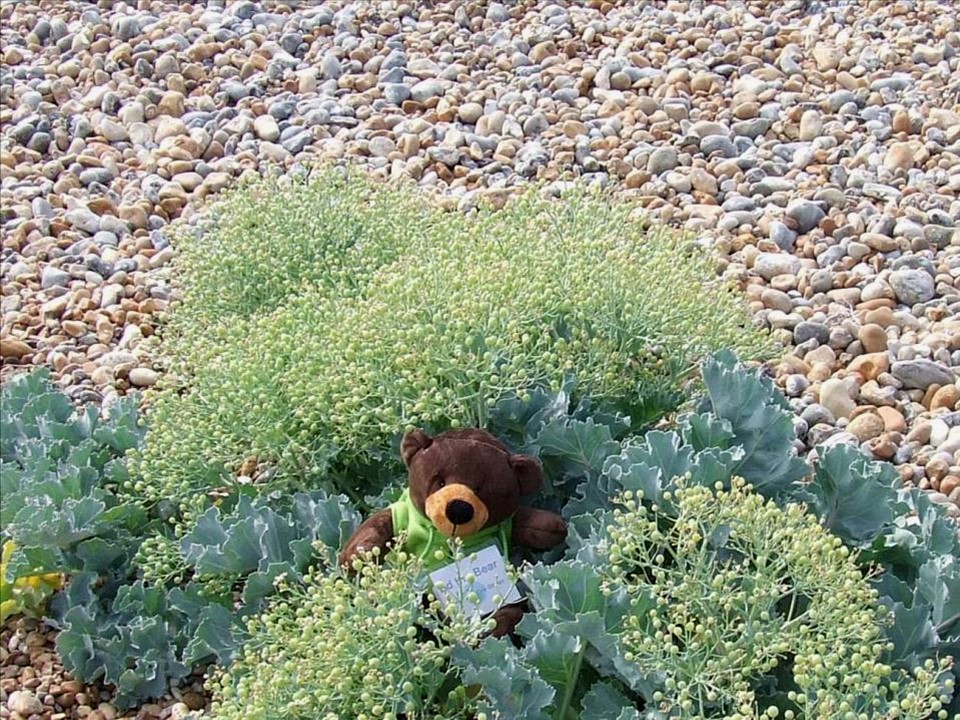
As you know, my local beach is part of the nature reserve. One of my favourite plants, Sea Kale, is now in flower.
This plant is called bitter sweet. This is a small plant, they grow much bigger. This plant is also called woody nightshade, related to deadly night shade.
The berries are poisonous.

Today we worked with a school group who were learning about the nature reserve. They did a transect survey of the shingle plant communities.
This means they measured a straight line from the top of the beach down to the high tide mark. They then divided this straight line into 1 metre squares and recorded the different plants they found.
They used special identification sheets so that they could recognise the different plants.

Later we recorded the different animals that we could see.


I saw this herring gull trying to break open a seashell. It kept flying up into the sky and then dropping the seashell to break it so the gull could eat the animal inside.

We saw birds visiting the plants as well. We also saw lots of lizards that were enjoying the sunshine.

My buddy Steve has been studying the bees that visit the special vegetated shingle plants. The bees pollinate the flowers so they are very important. The children helped to record the bees we saw.
This is a two banded bumble bee on the sea kale flowers.

This is a honey bee on the sea kale

This is a red tailed bumble bee visiting a yellow horned poppy flower.

This red tailed bumble bee is visiting the thrift

There many other insects on the plants
This woolly caterpillar will grow into a beautiful garden tiger moth


We saw these two beetles as well.

There were also many spiders, some in webs others like this zebra spider runs along the ground. It is a type of jumping spider which can also jump from plant to plant.

We saw lots of different animals and of course the most important thing about the vegetated shingle is that it is a rare habitat both in the UK and worldwide. I am really lucky to live near such as special beach.

Bye for now

Ed the Bear


Sunday, 18 October 2009

Beach Clean Event

Here I am back on Shoreham Beach to help out at a litter clean event organised by the Friends of Shoreham Beach. Litter is a big problem on many of our beaches and Shoreham Beach is sadly no different. Not only does this litter make the beach look very messy but it is also very harmful to wildlife.

This is Joy introducing me to all the volunteers who have come to help clean the beach.

As you can see there were a lot of volunteers, (50 in total) a mixed group of helpers of all ages. They worked really hard cleaning up the litter. My legs are very short and it was a bit hard for me to keep up, walking on all those pebbles, so two girls, Eva and Alice carried me for a while in their back pack.

We collected almost 30 bags of litter in total, phew! This is us all having a well deserved break.

Out of all the different types of litter found on the beach the most common material is plastic. This does more damage to wildlife, in and out of the water, than any other type of litter. A million sea birds and 100, 000 marine mammals around the world die each year from being entangled in, or by swallowing, plastic litter. About 30 - 40% of the litter found on the beach is left behind by beach visitors. This means that if we could encourage people to take it home instead of leaving it on the beach this would make a big difference.
Better still, people can take their litter home and recycle it along with the rest of their household rubbish. Removing all the plastic rubbish in the ocean is impossible. We can all help though by making sure no more plastic ends up in the ocean. Recycling can also save oil, as this is used to make new plastic items.

At the Eco Schools conference we took part in all the participants (including ourselves) were given a bag like the one below.

It may be hard to believe but this bag was made from recycled plastic bottles. I hope you all recycle as much of your household rubbish as you can.

Bye for now

Ed