Hi all
I have just heard from Ron Hirshi and Fred the Monkey about the damage that the Tsunami have done to the beaches and wildlife in the Hawaiian Islands, including many places I visted when I was staying with Ron and Fred.
Ron and Fred have written about this on their own weblog called Project Soar. I could not say it better, so here is the link including news about a 60 year old Laysan Albatross called Wisdom who survived the Tsunami
http://soaronhirschi.blogspot.com/2011/03/wisdom-returnsmanao-akamai.html
Bye for now
Ed the Bear
Tuesday, 22 March 2011

Friday, 11 March 2011
Tsunami disaster
Hello
I am sure you have all heard about the terrible Earthquake in the ocean near Japan. This is a terrible disaster, the worst of the damage coming from a huge wave which is called a Tsunami. This was caused because the earthquake was underwater.
You may remember that when I was in the Hawaiian Islands in February last year there was an earthquake in Chile which was also terrible. This also caused a tsunami rushed across the ocean towards the Hawaiian islands. Everyone was evacuated to safety, including myself and sanctuary Sam. We took shelter in a 12 story building with other volunteers who had come to take part in the annual whale watch.
Lucky for us the wave lost much of its energy and did not cause any damage in Hawaii. This time, the tsunami did reach Hawaii and did cause some damage. Its not clear at the moment how much damage.
This time the wave was larger (because the earthquake was nearer to Hawaii) and not only reached the Hawaiian Islands it continued on to the West Coast mainland of the US. I have made lots of frinds in my travels thrught this area and I hope they are all safe.
More news soon
Ed
Saturday, 19 February 2011
Brighton Science Festival Fun
Hi all
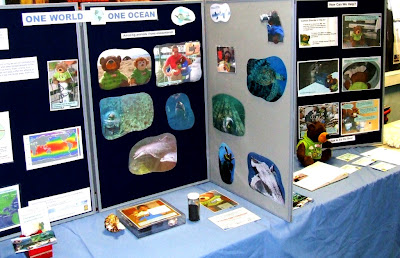
Here I am at the Brighton Science Festival.

The display explains all about my adventures, this includes the following information.

 Ocean Biodiversity
Helping the oceans
Our display also show some of the people I have visited that are doing things to help protect the oceans. Ron Hirshi and Fred the Monkey who help clean beaches of dangerous plastic and educate people about the dangers to wildlife. I visited a turtle hospital where they rescue sea turtles and return them to the ocean. I helped with an oil spill and visited a laboratory where they are growing corals to replaces a nearby damaged reef.
The display also tells people about the Black Scuba Diver Youth Summit I visited and the new friend Lisa I made. This is me receiving a special certificate at the Youth Summit.
 Living more sustainably
We all have an impact on the environment and the oceans. But its important to know that by doing things slightly different we can reduce our impact on the oceans. Our display encourages children (and adults) to think about how they could do things differently to live more sustainably and have less impact on the oceans and the environment. They make a list and sign a pledge to me, Ed the Bear.
Ocean Acidification Experiment
One of the most scary things I have found out about during my travels is ocean acidification. The increase in carbon dioxide in the air means more carbon dioxide in the oceans. When too much carbon dioxide is in the ocean it creates a weak acid. This make the oceans more acidic and makes it difficult for animals such as corals, crabs and sea snails to build their hard calcium carbonate shells.
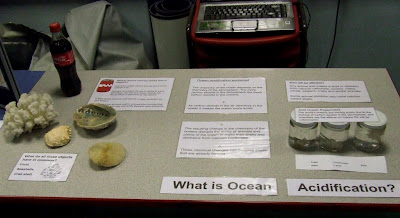 The experiment we set up shows what will happen if the oceans become too acidic - animals with hard shells will dissolve. We used three jars. One had freshwater, one had half freshwater and half weak acid (vinegar) and one jar had just vinegar. We put a seashell in each jar. The one in freshwater stayed the same. The shells in both the other two jars started to dissolve. This is what will happen in the oceans. Most people we spoke to had not heard of ocean acidification.
A chap called Colin helped us as well. He has done lots of diving like me and brought along some beautiful pictures of the ocean wildlife he had seen.
The Friends of Shoreham Beach brought along their display about Shoreham Beach, the fascinating plants and animals that live there.
 They also had a marine litter display showing some of the litter washed up on Shoreham Beach and how long each item takes to biodegrade.
 They also had a colouring activity about marine litter which was also popular.

There was also an exhibit about local marine life and the strandline objects washed up on the beach.
 They also had a great activity for the children making a rock pool in a bottle.
To stop litter getting into the oceans we need to dispose of it responsibly. Much of it is reusable so it is important to recycle what we can.
 As I walked around the other exhibits I saw this display explaining how the items that are collected for recycling are separated into different materials.
 This is a working model showing how this is done.
There were also lots of other great scientific demonstrations going on.
 This is a giant millipede.
 There were excited children and adults everywhere and being a little bear I decided to go back up to my display before I was accidentally trodden on.
It was a great day. Lots of adults and children asking lots of questions about the oceans and about the threats to oceans.
I am only at the science festival on the 19th February, but the festival continues for another couple of weeks, so if you live in Sussex (UK) then you might like to go along. Here is the website to check out what is yet to come.
http://www.brightonscience.com/2011/
Bye for now, Ed
Here I am at the Brighton Science Festival.

I am here with my buddy Steve with our One World One Ocean display. Last year my sister Bella brought along a display because I was in the USA. This time I have been able to come in person.
The display explains all about my adventures, this includes the following information.

Why is Ed the Bear travelling?
The display starts of by explaining that I have been travelling since I discovered that my local beach (home to UK and globally rare vegetated shingle habitat) is in danger from global issues such as climate change. I decides to travel to other seas and oceans to help me understand these global problems, how they might affect my local beach and what could be done about it.
On the way I encountered some amazing wildlife both locally and globally. I have seen majestic whales and albatross, playful sea otters, rare monk seal, turtles and much more. With my purpose built diving bell, I have dived on stunning coral reefs and ship wrecks.
Threats to ocean
Our display also shows some of the many threats I have found out about, many of them are affected by our modern living, such as climate change that may cause sea level rise, extreme weather conditions, killing coral reefs and disrupting food chains (latter even around the UK). I found out about ocean acidification, which may threaten many hard bodies many invertebrates, marine debris etc.

Our display also show some of the people I have visited that are doing things to help protect the oceans. Ron Hirshi and Fred the Monkey who help clean beaches of dangerous plastic and educate people about the dangers to wildlife. I visited a turtle hospital where they rescue sea turtles and return them to the ocean. I helped with an oil spill and visited a laboratory where they are growing corals to replaces a nearby damaged reef.
The display also tells people about the Black Scuba Diver Youth Summit I visited and the new friend Lisa I made. This is me receiving a special certificate at the Youth Summit.

We all have an impact on the environment and the oceans. But its important to know that by doing things slightly different we can reduce our impact on the oceans. Our display encourages children (and adults) to think about how they could do things differently to live more sustainably and have less impact on the oceans and the environment. They make a list and sign a pledge to me, Ed the Bear.
Ocean Acidification Experiment
One of the most scary things I have found out about during my travels is ocean acidification. The increase in carbon dioxide in the air means more carbon dioxide in the oceans. When too much carbon dioxide is in the ocean it creates a weak acid. This make the oceans more acidic and makes it difficult for animals such as corals, crabs and sea snails to build their hard calcium carbonate shells.

A chap called Colin helped us as well. He has done lots of diving like me and brought along some beautiful pictures of the ocean wildlife he had seen.
The Friends of Shoreham Beach brought along their display about Shoreham Beach, the fascinating plants and animals that live there.


There was also an exhibit about local marine life and the strandline objects washed up on the beach.

To stop litter getting into the oceans we need to dispose of it responsibly. Much of it is reusable so it is important to recycle what we can.


There were also lots of other great scientific demonstrations going on.


It was a great day. Lots of adults and children asking lots of questions about the oceans and about the threats to oceans.
I am only at the science festival on the 19th February, but the festival continues for another couple of weeks, so if you live in Sussex (UK) then you might like to go along. Here is the website to check out what is yet to come.
http://www.brightonscience.com/2011/
Bye for now, Ed
Saturday, 29 January 2011
Teaching children about the oceans
Hi all
Today I made some new friends while helping my buddy Steve to teach children about the ocean. I took my sister Bella along as well. She has her own adventures and weblog.
 These children were as passionate about the ocean as I am and when they found out how the ocean is in danger, they were pleased to find out that there were things they could do to help.
Steve explained that I have been travelling the oceans to find out more about global issues since I found out that my local beach was in danger from climate change. We started the session with a quick yes or no quiz to find out what the children already knew.
We then asked the children to draw a line between different points on a map. The only rule was they could not cross any land.
 When they had finished the children realised that all the seas and oceans and linked together forming one big ocean. This one big ocean joins us all together.

We then asked the children if all sea animals could travel from one ocean to another. They said no. We then asked them what might stop animals doing this. The children suggested things like water temperature, depth, salinity, land and hiding places. We then asked if there were any animals that could travel from one ocean to another and the children decided that whales could. Wow they had already learned loads about the oceans and the course had only just started.
We then did a quiz about sound. For many land animals, sight is their most important sense. But underwater it might be dark and murky so many animals communicate using sounds, even some fish.

Today I made some new friends while helping my buddy Steve to teach children about the ocean. I took my sister Bella along as well. She has her own adventures and weblog.

Steve explained that I have been travelling the oceans to find out more about global issues since I found out that my local beach was in danger from climate change. We started the session with a quick yes or no quiz to find out what the children already knew.
We then asked the children to draw a line between different points on a map. The only rule was they could not cross any land.


We then did a quiz about sound. For many land animals, sight is their most important sense. But underwater it might be dark and murky so many animals communicate using sounds, even some fish.

To explore the world of underwater sounds, the children did a sound quiz. These sounds included humpback whales, bearded seals, herring gull, striped grunt fish, snapping shrimps, undersea earthquake and a ships propellers. The children had to decide which sound was which.


They also found out about some of the other characters I had met on my travels, such as Fred the Happy Face Monkey. If you have been following my travels you will know I met Fred and his buddy Ron Hirshi in Marrowstone Islands and travelled with them to Kauai, one of the Hawaiian Islands. Can you see the beautiful sea turtle coming up on the beach behind us.
 I learned a lot about marine debris and the Laysan Albatross who suffer terribly because of this litter. The children will find out more about that later.
We discussed what kind of objects make up marine debris asked the children to suggest how marine debris might end up in the ocean. They looked at some pictures of some of the places I had visited where marine debris was a big problem. They come up with many ideas; people leave it on the beach, it comes from boats, activities like fishing and some gets blown into rivers and washed down to the sea. We then discussed how this could harm wildlife.
To help them understand the problem of marine debris better we looked at the Laysan Albatross. Steve has devised a species activity which replicates the problem these albatross face.
In this activity the children work in small groups of 3. Each group will be a Laysan albatross family living on the Hawaiian Islands where they nest. Laysan albatross have one chick.


Each parent bird will take it in turns to collect food for their chick, represented by the many cards on the floor. Face down, the cards will either be food items of plastic litter. However, like the albatross, you will not know if it is food or plastic litter that you are taking back.


 This group is lucky and seem to have only collected squid
The child then have to add up how many food items and how many plastic debris items they collected for their chick. If only a small amount of plastic is eaten, the chick could regurgitate it. The children were asked if they thought their chick had survived. We then discussed that the problem is even more complex. Some chicks swallow lead paint chips which are poisonous, making them weaker and more at risk from dying from swallowing plastic debris.

The children were asked if they were surprised by the type of objects that made up this plastic marine litter that the albatross accidentally fed to their chicks. They said they were. I was surprised too when I first found out from Fred the Monkey.
After looking at some more of the amazing animals I saw on my travels, we then did some activities about climate change and the damage that this is doing to the oceans. Climate change is causing the polar ice to melt, which will cause sea level rise on land but may also damage the ocean currents that create our weather and climate. The children also found out how climate change is killing corals and disrupting food webs - even around the UK.
All of these are very scary. However there are many people I meet on my travels who are helping the oceans.
 In the Mote Laboratory they are growing corals in special tanks which will be used to help repair a damaged coral reef. NOAA, with whom I spent many months last year, look after 14 marine sanctuaries set up to protect the marine habitat and the animals that live there. And of course Ron Hirshi and Fred the Monkey who are doing really important work raising awareness of plastic litter, including the tiny bits of plastic that float in the ocean and helping to keep their local beach clean from plastic.

We all contribute towards climate change because of modern living (even me and Steve!). But there are lots of ways that we can do things differently that will help the environment. We asked the children to think about things that they could do to reduce the impact they have on the oceans.
 They came up with lots of good ideas. We can turn of computers and lights when they are not being used.
 We can make sure we recycle all we can and dispose of things properly if they can't be recycled.
Water is very valuable, we need to make sure we don't waste this valuable resource.
One of the children, called Joe, came up with a very good way to describe what we should do. He said we need to use these things more wisely.
 The children made a list of the things they plan to do to help reduce their impact on the oceans and then they signed a pledge to me, Ed the Bear, to do their best to follow their list.
The children were really excited that they could do something to help the ocean.
It was a very fun time
Bye for now, Ed the Bear


I also told the children a bit about the beach where I live and the special plants that grow there which make a special habitat called vegetated shingle. The plants are also home to many birds, insects and even lizards.

They also found out about some of the other characters I had met on my travels, such as Fred the Happy Face Monkey. If you have been following my travels you will know I met Fred and his buddy Ron Hirshi in Marrowstone Islands and travelled with them to Kauai, one of the Hawaiian Islands. Can you see the beautiful sea turtle coming up on the beach behind us.

We discussed what kind of objects make up marine debris asked the children to suggest how marine debris might end up in the ocean. They looked at some pictures of some of the places I had visited where marine debris was a big problem. They come up with many ideas; people leave it on the beach, it comes from boats, activities like fishing and some gets blown into rivers and washed down to the sea. We then discussed how this could harm wildlife.
To help them understand the problem of marine debris better we looked at the Laysan Albatross. Steve has devised a species activity which replicates the problem these albatross face.
In this activity the children work in small groups of 3. Each group will be a Laysan albatross family living on the Hawaiian Islands where they nest. Laysan albatross have one chick.


Each parent bird will take it in turns to collect food for their chick, represented by the many cards on the floor. Face down, the cards will either be food items of plastic litter. However, like the albatross, you will not know if it is food or plastic litter that you are taking back.


Each group recorded the items collected for their chick. These ranged from squid to plastic items such as bottle tops, plastic toys, disposable lighter and many other objects.


The child then have to add up how many food items and how many plastic debris items they collected for their chick. If only a small amount of plastic is eaten, the chick could regurgitate it. The children were asked if they thought their chick had survived. We then discussed that the problem is even more complex. Some chicks swallow lead paint chips which are poisonous, making them weaker and more at risk from dying from swallowing plastic debris.

The children were asked if they were surprised by the type of objects that made up this plastic marine litter that the albatross accidentally fed to their chicks. They said they were. I was surprised too when I first found out from Fred the Monkey.
All of these are very scary. However there are many people I meet on my travels who are helping the oceans.


I also visited a hospital where they rescue sea turtles. This is me and sanctuary Sam with Scooter a rescued turtle. We also told the children about other people I had meet who are helping the ocean too.
We all contribute towards climate change because of modern living (even me and Steve!). But there are lots of ways that we can do things differently that will help the environment. We asked the children to think about things that they could do to reduce the impact they have on the oceans.


Water is very valuable, we need to make sure we don't waste this valuable resource.
One of the children, called Joe, came up with a very good way to describe what we should do. He said we need to use these things more wisely.

The children were really excited that they could do something to help the ocean.
It was a very fun time
Bye for now, Ed the Bear
Sunday, 16 January 2011
Catch up on my Flower Garden Banks National Marine Sanctuary
Hi all
You may remember back in May last year that I visited the Flower Garden Banks National Marine Sanctuary. However, there were a lot of problems at the time including the terrible oil spill and so I did not get the chance to include this trip on my blog
Below are a series of pictures of my visit. Fred and I would be travelling out with some of the staff on the research vessel Manta where they would be using a remote controlled vehicle to take photographs of marine life.
I would not get the chance to use by diving bell in the sanctuary but I did help them check some equipment in a pool.
 Here I am checking out the underwater camera equipment from my own submersible.
 Sanctuary Sam, keeps an eye on things from the surface of a pool, while I explore below with my submersible.
 In a swimming pool, I help the researchers make sure the camera gear used for monitoring is ready for action.


 I check out the view from the pilot house with Sam.
 Here I am checking on a dive tank on board the R/V Manta. Hard hats and life jackets are required gear when working on deck.

You may remember back in May last year that I visited the Flower Garden Banks National Marine Sanctuary. However, there were a lot of problems at the time including the terrible oil spill and so I did not get the chance to include this trip on my blog
Below are a series of pictures of my visit. Fred and I would be travelling out with some of the staff on the research vessel Manta where they would be using a remote controlled vehicle to take photographs of marine life.
I would not get the chance to use by diving bell in the sanctuary but I did help them check some equipment in a pool.


Here I am signing in for my research trip on board the R/V Manta.

Sam and I get settled in to our bunkroom on board the R/V Manta.


Sam and I get a chance to try out the controls of the remote controlled vehicle (ROV)
It sure was fun. I really enjoyed my trip on the Manta.
Still planning my trips for this year, I hope to be on my way soon.
Bye for now
Thursday, 13 January 2011
All About Bears
Hi all
I am planning my travels and adventures for this year. My buddy Steve has been ill with the flu and then a chest infection so we are a bit behind in our plans
I did watch some television and saw a very interesting programme about my wild cousins the black bear. If you have ever wondered what bears where like, you must watch this programme. This is the link to the first of three programmes.
http://www.bbc.co.uk/iplayer/episode/b00x9yfv/The_Bear_Family_and_Me_Spring/
I hope you enjoy finding out about my wild cousins
Bye for now, Ed
Saturday, 25 December 2010
Ed the Bear wishes you all a happy Christmas
Hi all
Wishing you a happy Christmas and a happy and healthy 2011. I am also wishing for a healthier ocean in 2011 too.
 Here I am in the snow, dreaming of some of the warmer places I have visited this year.
I hope you will continue to follow my travels in 2011 and learn with me about some of the amazing marine life and how we can all help the oceans
Bye for now, Ed the Bear
See you in 2011
Wishing you a happy Christmas and a happy and healthy 2011. I am also wishing for a healthier ocean in 2011 too.

I hope you will continue to follow my travels in 2011 and learn with me about some of the amazing marine life and how we can all help the oceans
Bye for now, Ed the Bear
See you in 2011
Subscribe to:
Posts (Atom)


