Monday, 21 June 2010

Day 1 A morning of experiments at Amy Slate Resort

Hi all

I have already made lots of friends at the NABS Youth Summit and I am looking forward to learning lots of great stuff with them over the next few days. As I will be working with the youths and we will be learning things together, I have decided that it would be great to ask the youths to write some of my blog entries for me.

We made an early start, departing the hotel where we were staying and drove 20 miles to Amy Slate Resort. We were greeted by the staff of the resort and Florida Keys National Marine Sanctuary staff.

During the morning we would be undertaking activities at five different stations. At one station we would learn about the salinity by collecting water samples, oxygen dissolved in seawater, a weather station, collecting water samples from deeper water (without getting wet) and measuring how cloudy the weather is.

SALINITY STATION
Students collect water from the Gulf of Mexico side of Key Largo to determine the salinity of the water. They place water drops on the plate of their refractometers and peer through the eyepiece to read the scale inside to determine the percentage of salt contained in the water. Ocean water is typically 35 parts of salt to 1000 parts of freshwater usually recorded as 35 ppt. Freshwater of course registers at zero. The higher the salinity, the more buoyant swimmers and divers will be.

DISSOLVED OXYGEN STATION
This is the dissolved oxygen station

Disolved Oxygen Station, me. Chanel, Octavia, L Whitney

Hi my name is Ed Bear and I’ve got a riddle for you.


If five fish are swimming and two of them drown. How many fish are left? If you’ve heard this riddle before and answered “Five, because a fish can’t drown.” I hate to say it but you’re wrong. Fish can drown. You’re probably wondering how because fish breathe water, don’t they? Well no they don’t. They breathe oxygen, dissolved oxygen to be exact and if there’s no dissolved oxygen that poor fish will drown.


In Key Largo I was given the chance to learn how they measure dissolved oxygen. In order to measure dissolved oxygen you take a small glass vial filled with a special chemical that turns blue when it touches water with oxygen in it. You place the vial in a plastic tube that looks sort of like s syringe. Place the tube in the water and push down on the vial to break the seal.
This is kind of hard for me to do because bears don’t have opposable thumbs but you should have no problem. The water will then come rushing into the vial and start changing color.
The bluer the solution, the more oxygen present in the water. As you may imagine the water at Key Largo was a deep blue with dissolved oxygen measuring at about 4 parts per million (ppm). Giving the fish enough oxygen to breathe comfortably and not drown.


This entry was written by Octavia Shaw

WEATHER STATION
Weather Station – At the weather station students read air and water temperatures, wind speed or velocity, the barometric pressure and the level of humidity or the amount of moisture the air is holding. Weather data is important to record when doing any kind of field work since weather influences and affects everything we do and all organisms on our Ocean Planet.

Ed Bear here, in Florida they are constantly looking out for changes in the weather to ensure they are prepared for future weather disasters. We were able to calculate the percentage of clouds in the sky by imagining all the clouds pushed together in the sky and determining how much of the sky they will occupy. We felt that the percentage of the clouds were about 45%. We also had a chance to measure the wind with an anemometer. This device is a tall cylindrical tube that has two holes on one side (one close to the top and one close to the bottom). This gave us fairly precise measurement of how much wind is blowing. Last but not least we measured the direction of the wind using a compass. Turns out we found the wind to be blowing east. You can learn so much with the weather.


This entry was written by L’Whitney Gowans

SECCI DISK STATION
Every time you go to the Keys, you ALWAYS learn something new. Especially when you learn some new crazy name about a tool used for visibility or depth. That tool is the secci disk.

It is a black and white plastic disk that is connected to a measuring tape (just as simple as it sounds). To start the calculations, we lowered it down into the clear water and watched as it was harder to see as it decended into the unknown. I, Ed bear, however could see that the “unknown” was actually some bare substrate on some rocks and covered in algae. Measuring the visibility from the disk was actually harder then looking into that “unknown”. (You may remember I watched some students using this last time I was here)


How you measured it was, you had to find out how far the disk was from the water, subtract that from the actual depth (using the secci disk of course), and finally you have successfully accomplished your task. I bet I would have learned more at the station if I wasn’t whisked away to the next but what I did get out of it was this; don’t underestimate the power of a plane plastic disk. It could just be the scientific fact that could solve a disaster.


This entry was written by Jessica Silk (SCUBAnaut)

NISKIN TUBES STATION
Niskin Tubes. Ashley, Evan,Kwadjo, Terrance, Massai, Teaon

Hello everyone this is Ed bear, and I’m enjoying the sun shine state in the Florida Keys with NABS/YES. Today we learned about a variety of subjects having to do with Water quality testing methods NOAA uses in there Marine Sanctuary. One of those methods was the Niskin bottle; I used it to retrieve water from depth to be tested. The device is spring loaded and so when it reaches the right depth, you use a small weight to set off the release of the closing system, by sending it down the retrieval line.


The container then closes and traps about a litre of water inside and can then be hauled back to the surface. The Niskin bottle can be used on a boat or from shore making it versatile and it appears to be made from sturdy replaceable materials making it a perfect tool for a range of environments. In a real life testing situation you would then take that water and test it at the other stations. I worked hard to get the system to function
correctly, and eventually I was able to increase my skill and take a sample from the dock water where we practiced. I learned many skills to day the Niskin bottle was one of the trickiest


This entry was written by Wadjo Tillman

Today at the youth summit we had a blast! The day was organized by different learning stations. We learned about dissolved oxygen, water salinity, and secchi disk. In the lab about dissolved oxygen we leaned the importance of having it in the water, and the way that the levels are measured. The water salinity station, which was taught by Mrs. Cathy Sakas, was also very interesting. We learned the scale that is use to measure the amount of salt in the water, and how to read the information that we collected using the Refractometer. One of the last stations that we went to was the secchi disk, which is used to measure the clarity of the water. It’s very simple; all you do is lower the disk into the water until you can’t see it anymore. Then you record the depth to where you could no longer see the disk. Then look at the scale that is provided to see find the clarity of the water. Over all we had a great day and learned a lot. I can’t wait to see what we get to do tomorrow.


This entry was written by Bresha
Wow we found out so any things about the ocean and much of the equipmemt was quite tricky for a bear with such little paws, so it was great to have help from my new friends. And that was just the morning! Ed

An afternoon of snorkelling

Hi all

After the NABS/YES youth went through their 5 stations, we all went snorkeling. They were all too excited to write a blog on this, as this was the youths first chance for snorkeling, but I think the pictures speak for themselves.
We went out on the boat, Amoray Diver.
Sanctuary Sam helped to drive the boat. (He did quite well, at least we didn't hit anything).

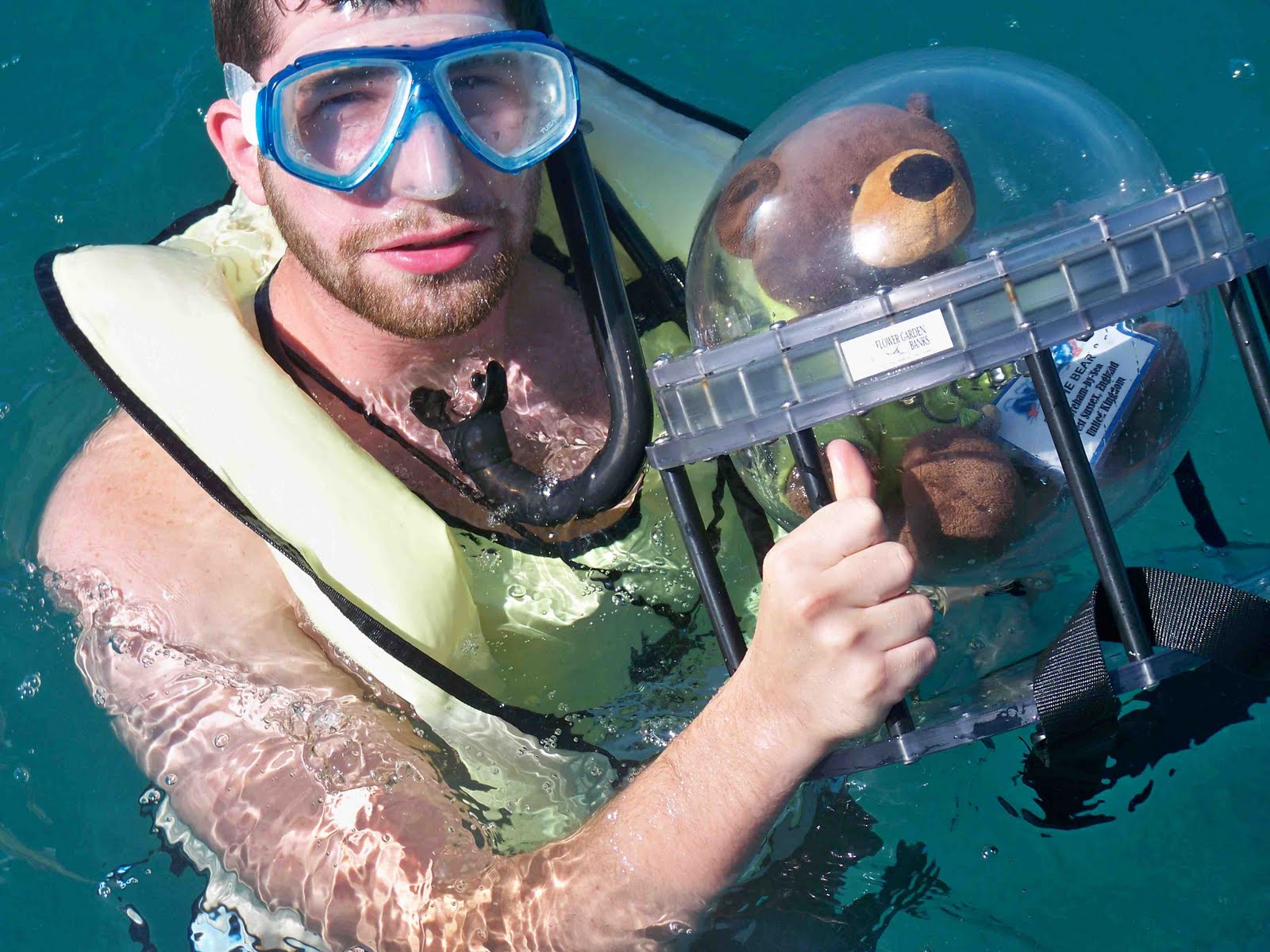
I got the chance to go out with them with my underwater diving bubble. Matthew Taylor from NOAA took care of me much of the time.
Me and Matthew

Here I am with Matthew and the YES Youths, they look like they are having great fun!

As you can see, the water was a lot more cloudy than when I was here last, I felt like a living secchi disk
I was glad Matthew was keeping an eye on me as I was a bit worried I might get lost and no one would be able to find me.
We didn't use any diving weights this time so  could easily pop back up to the surface, Matthew as well if he was holding on - weeeeeeeeeeeeeeeeeeeeeee.

This is me on the coral reef with Ashley

Here I am with the the YES Youths.
Here I am back on the surface with Ashley and Kwadjo.

Eventually it was time to go, the snorkeling trip finished our day. It was such fun and great to have the company of my new friends.

I'm feeling a bit peckish after all this excitement. Time for a honey and banana sandwich and off to bed. I here it will be another busy day tomorrow. Ed

Sunday, 20 June 2010

Ed arrives at NABS YES and makes some new friends.

Hi all

Well here I am at the NABS Youth Summit. Something I have learned over the last few months is that everything does not always go to plan and this has been no exception.
Cathy Sakas from NOAA had car trouble, so we arrived late for the registration. Meanwhile, Ken was having problems of his own. Ken had planned to pick some people up from Miami Airport but their plane was late – so Ken and these inbound travelers were unavoidably late for the registration. This meant I did not get to meet everyone that night.

However I did get to meet quite a few people. They were really jolly, friendly and really welcoming.
Here are some of the fun people I met on the first night.
Here I am meeting L Whitney Gowans...
...and this is Matthew Edwards
This is Octavia Shaw...
...and this is Terrance Adams
Sam and I met Lis, Spencer and Alexis
Here I am with Jessica Silk, she leant me her sun glasses - do you think they make me look cool!
This me with Ken Stewart, I was really looking forward to meeting him and shaking him by the paw.
This is me and Sam with two of the YES chaperones. I guess they are here to make sure we don't get into any trouble or up to any mischief.

It was great to met everyone and they are so friendly and welcoming. Very tiring though for such a little bear so I had to make my excuses and go off to bed. I know there is lots planned for tomorrow. I hope I won't be too excited to sleep...............zzzzzzzzzzzzzzzzzzzzzzzzzzzzzzzzz

Saturday, 19 June 2010

On my way to NABS YES

Hi all

Next stop will be the NABS YES at Florida. NABS stands for National Association of Black Scuba Divers and YES is the Youth Education Summit.

I have enjoyed the different sites I have visited here in the US more than words can say (but if you have read my earlier blogs you should at least have some idea). Even so, I have been particularly excited about the chance to visit and take part in the Youth Summit since I first heard about the project earlier in the year.

I am looking forward to meeting Ken Stewart who has been making a short video clip about my adventures. Ken is the Programme Director (and co-founder) of the Tennessee Aquatic Project (TAP).


TAP is a program that helps at risk and inner city youth, aged 8 to 18 year, to connect to diving and the ocean. Even more importantly, TAP provides a complete approach to personal development and support system which I am told will help them change their lives for the better. The ocean is a great way to make this happen as it is a place that is both exciting but also still holds many mysteries and of course we are all connected by the ocean too!

To find out more about the TAP project, follow the link below

http://tennesseeaquaticproject.org/

Ken has been using my adventures to help teach his TAP students about the ocean. Ken and the students have been following my adventures when they meet each Saturday. My visit to the Youth Summit will mean that they will become part of my adventures as well.
I am really proud to have the chance to be involved in this very special project and can’t wait to meet everyone – including the kids who appear in the Ed the Bear video clip Ken has been working on.

Bye for now, Ed

Saturday, 12 June 2010

A quick detour to the UK for World Oceans Day

Hi all

It’s me Ed and guess what, Im back in the UK for a few days. I had to come back and take part in the Adur World Oceans Day Event which takes place on the edge of the river Adur very close to my local beach.
I arrived in time to help my buddy Steve set up a display about my travels and I brought along some of the things as well. I heard that the event would be guarded all night by a security chap.

As the display included my journal and several other valuable items I volunteered to stay at the marquee over night and give a helping hand to keep everything safe. I did get to have a sleep for part of the night too as I needed to be refreshed for the days event.

I was going to give the Friends of Shoreham Beach (FoSB) a hand on their display. As you know Shoreham Beach is my local beach, which is also a nature reserve because of its rare vegetated shingle habitat. FoSB help to keep the nature reserve safe and also teach people about this rare and important habitat. The FoSB people at the event said that they had lots of helpers this year, so they would be okay without my help, so I could concentrate on telling people about my travels, the amazing wildlife I had seen and the terrible damage too.

As you will know, the fact that this rare habitat at Shoreham is threatened by climate change and other global issues was the reason I started my travels in the first place. I popped over to the beach first to check on the plants as they are at their most spectacular at this time of the year.
This is one of my favourite shingle plants, Sea kale

Here I am taking a close look at the sea kale - this one has started to produce berries

This plant is calledViperes Bugloss

The event officially started at 10.00am but people were already looking around the exhibits at 9.30am. The World Oceans Day Event was housed within a large marquee on coronation green right on the edge of the river. This was a great location.
Next to me my stand was the Shoreham Angling Squad so I made sure I had the chance to swap tips with them. Later in the day, one of the fishermen set up his gear on the river and I was very tempted to join him, you know how much I enjoy fishing.
We spoke to lots of people about the amazing places I had visited and the fascinating wildlife I had encountered such as whales, seals, sea otters, turtles and much more. the local newspaper told everyone I was coming to the event so lots of people turned up to find out what I had been up to.
A lady spoke to me about these amazing leafy sea dragons she had seen in an aquarium in Japan. I told her that I was planning a trip to Australia very soon and I was hoping I would get to see leafy sea dragons while I am there.

People also had the chance to look through my journal, which they said was really fascinating.
It also contained lots of pictures (taken by Ron) from my visit to Ron Hirshi and Fred the Monkey and my trip with them to Hawaii – many of which have not appeared on my weblog. The journal also included my trip to Spokane where I was cared for by Methea Sapp. People could see a selection of some of my own collection of seashells and other objects from my travels.
I told people about the important wortk that Fred the Monkey and Ron Hirshi have been doing to raise awareness of marine litter and the deadication to cleaning plastics from tehi local beaches in Marrowstone Island and Hawaiian Islands. I gave them Fred's weblog address so that they can find out more about the amazing things he has been doing. I told people that they could also see what happened when Fred and I first meet last year. If you haven't aslreay checked out Fred and Ron's site, its here http://soaronhirschi.blogspot.com/

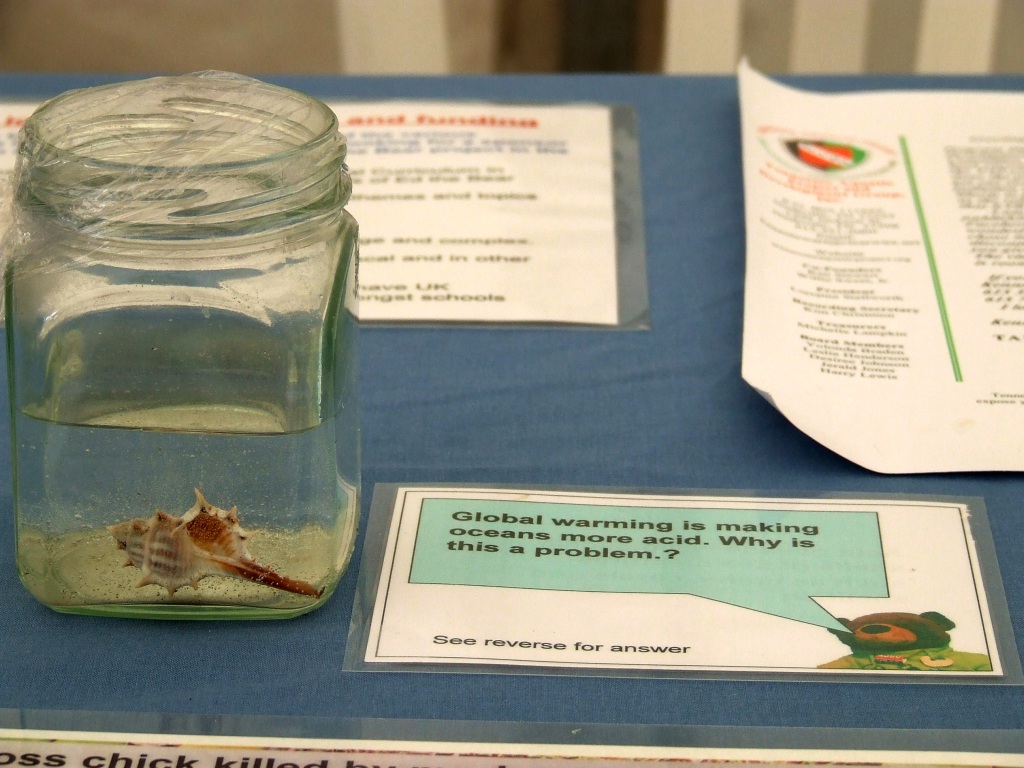
I also had an activity to warn people about acid oceans, caused by the oceans absorbing too much carbon dioxide from the air.
This is making the oceans more acidic – I put an empty seashell into a weak vinegar (acetic acid) solution to demonstrate just how even a weak acid can dissolve the seashells, corals and other animal homes made from calcium. Steve and I also spoke to a lot of children about my adventures and showed them how they could follow my adventures on my blog.

World Oceans Day was a great event. I had a look round to see the other displays.
This is part of my buddy Steve's other display about local dolphin sightings


These tanks with local marine creatures where set up by the British Marine Life Study Society

The local rangers had a facsinating display about the sea strandline - all those fascinating shell, eggcases and other objects washed uop by the tide.
I decided not to get too close to these snappy edible crabs
I popped over to see how the Friends of Shoreham Beach were doing. This is part of their litter display. As you can see they were very busy with vistors so I didn't want to interupt them.
This is the display about the nature reserve, the fascinating plants and wildlife.

 
The event was really busy so I thought I had better get back to my display
It was a brilliant day. I said goodbye to my buddy Steve and headed off to the airport so I could get back to the USA.

Bye for now.Ed