Monday, 22 March 2010

Ed and Sam help students monitor marine life.

Sam and I went out with local High School students to help with the sanctuary’s environmental monitoring and education program, LiMPETS (Long-term Monitoring and Experimental Training for Students) that studies local beaches and rocky shores. We helped the students collect data on the abundance of specific plants and animals at study sites along the coast. We learned that every year about 3,500 students participate in this program that is a project of three of the California sanctuaries: Gulf of the Farallones, Monterey Bay and Channel Islands. Wow that's a lot of students.

At a sandy beach site – we counted, measured and determined the sex of sand crabs (Emerita analoga) found along our transect.

The trasect was a line made straight down the beach which the students studied for crabs. This is a good scientific technique to study an animal where the whole beach is its habitat. This can be repeated on different parts of the beach.
Every crab that we measured was carefully put back afterwards. Sand crabs are an important species in sandy beaches as they are the main food source for many shore birds and near shore fishes, so they are a good animal to monitor – if they are doing well, then probably the animals that feed on them are doing well also.

At rocky intertidal sites, we recorded about twenty types of organisms in quadrats at rocky shore sites. The quadrats are special squares that can be laid over the rocks and all the animals and plants present can be counted and recorded.
One of the species we recorded was this sunburst anemone

The students sample the same area each time they come out to see how the distribution and abundance of plants and animals change from season to season and year to year.

Sanctuary managers use this information to help protect the sanctuary. For example, in November of 2007, a large container ship; the Cosco Busan, ran into a bridge support and spilled oil into San Francisco Bay. Some of the oil went out into the sanctuary. Sanctuary staff were able to use the data from LiMPETS to compare the abundance and distribution of species before and after the spill. This helped them know which areas might need the most help to recover from the spill. So the students get to learn some fascinating stuff about marine wildlife and the sanctuary benefits from their studies too.

I really enjoyed helping the students monitoring the beach and finding out about the types of animal that live in the sand and rock pools.

Off to our next destination soon, but Sam is keeping it a secret. I wonder where we will travel too next?

Bye for now Ed

Wednesday, 17 March 2010

A day kayaking in the sun

Hi all

Today Sam and I had a special treat – we got to go kayaking on Tomales Bay, part of the Farallones Sanctuary, with several sanctuary staff. Oh yes, a  kayak is a type of canoe, just incase you were wondering. 
 Sam ansd I Kayaking

We had a really fun day – we paddled up along the coast of the bay and saw osprey, cormorants, king fishers, grebes, turkey vultures and even a couple of harbor seals like the ones back home.
Harbour seal

We stopped at Pebble Beach and had lunch, before going on a short hike through the woods along the shore. We saw many flowers and trees (including a Redwood Tree) and even saw a Banana Slug – normally a bright yellow, this one was greenish – it must have been decked out for St Patrick’s Day!
Sam has been helping me build up my skills in the water so  thought I would teach him a bit about what bears love best. Climbing trees. We started with somethiung small....
...And progressed to a redwood tree

Banana slug

One of the women kayaking with us, Yuen, was from Vietnam. She is a graduate student in Ocean Policy in Seattle and has been involved in the Sanctuary International Program in Vietnam. She is visiting some of the West Coast Sanctuaries during her Spring Break to continue her education about sanctuaries and other marine protected areas.
Sam and I took this picture of the sanctuary folks who took us kayaking. They are (left to right): Carol, Yuen (visiting from Vietnam!), Angela, Sage, Christy, Kelley and Alison. They were a really fun bunch.

I commented that Tomales Bay was an interesting shape – it is long and narrow - and learned that Tomales Bay sits on top of the San Andreas Fault and is a submerged linear estuary that runs along the North American and Pacific Plate boundaries. (The Cordell Bank offices are not far from here – where I learned a bit about earthquakes a few weeks ago.)
Estuaries are places upon which wildlife depends – not only do they offer habitat for many animals, they provide spawning and nursery areas for many fish species, and they are an important food source for many local and migrating birds.

The sanctuary has been working with the local community to protect the habitats in Tomales Bay from water pollution, habitat loss, introduced species and other human-caused disturbance to these important ecosystems. Estuaries around the world face similar issues, 60% of the world’s population lives near an estuary.
This is the estuary near my local beach at Shoreham. It may not look much but the sandy mud is full of marine worms, crabs, sea snails, bivalve molluscs and lots of tiny shrimp-like crustceans. Lots of wading birds come to the estuary to feed on these tiny animals. Infact, UK estuiaries are even more important in the winter when they are visited by thousands of migrating wading birds that come to the Uk becaue the places they come from are much colder than British winters. Many types of fish also feed on these mud living marine creatures.
Wow, a great day kayaking and many more experiences of willdife and wild places.

Yawn! I think I need a nap

zzzzzzzzzzzzzzzzzzzzzzzzz

Monday, 15 March 2010

Gulf of the Farallones National Marine Sanctuary

Sanctuary Sam and I arrived at the Gulf of the Farallones National Marine Sanctuary offices in San Francisco, California today. This is quite near to the Cordell Banks Sanctuary offices I visited earlier this year. I’ve heard San Francisco is famous for its fog, and it was very dull when I came last, but today it was a beautiful, sunny day, and the Golden Gate Bridge, near the sanctuary offices, glowed a bright orangey-red – not golden at all!


Unlike the offshore Cordell Bank sanctuary, the Farallones sanctuary is right next to San Francisco where about 8 million people live. Lots of people, and lots of wildlife, all living side by side. The Farallones sanctuary protects the waters outside the Golden Gate Bridge and around the Farallon Islands, which are about 27 miles offshore. It also includes some shallow coastal areas, called estuaries, like Tomales Bay, and Bolinas Lagoon.
In this map you can see Gulf of the Farallones National Marine Sanctuary where I am now, the Cordell Banks Sanktuary where I visited before and Moneray Bay (my next destination)

But for now there So much to discover here! First we learned about the local wildlife with a Visitor Center tour. The visitors centre has life-sized replicas of white sharks and giant elephant seals.
I'm glad this great white shark is only a model. I know humans are not their usual prey but a little bear like me could easily be mistaken for a tasty morsel. My buddy Steve, back in the UK, teaches people about sharks and he has written books about sharks as well. Steve also has a seal shaped decoy which has been chewed up by great white sharks that the kids can handle.

The enormous elephant seal replicas were fabulous, and we even listened to recorded whale voices – something Sam has experienced before while actually swimming in the ocean with them! Awesome sounds!

The aquariums have big green and tiny pink anemones. They are so huge they look even more like plants.
 I was so surprised when I first discovered that sea anemones were actually animals. In another aquarium tank there was a monkeyface prickleback eel named Monty, some crabs, and a big abalone.

I learned that this part of the Pacific Ocean is one of the four most productive areas in the world because of something called “upwelling.” Along the coast here, strong springtime winds push the surface waters offshore and that brings cold water, which has lots of nutrients in it, up to the surface. Near the surface, the combination of nutrients and sunlight allows the tiny one-celled plants, called phytoplankton, to grow really fast – just like a garden that’s been fertilized. Lots of different kinds of animals eat this plankton, including little shrimp-like animals called krill. Krill is a very important food, and there’s so much of it here, giant blue whales come here in the summer to feed on and can eat up to four tons of it each day!

But many other kinds of animals live here, too: 36 species of marine mammals (like Sam’s buddies, the California sea lions, seals, sea otters, porpoises and dolphins), and thousands of different fish, birds and invertebrates – sea snails, limpets, sea stars and sea urchins. In fact, there is so much food here, that many animals travel thousands of miles just to come here and feed, including seabirds and even sea turtles. One bird, the Black-footed Albatross, flies here from Hawaii to get food to bring back for its chicks. It takes the bird three weeks to make the trip here and back – that is a really long way to go for a grocery run!

Black footed albatross

The Farallon Islands, a very rocky and jagged group of rocks, aren’t actually part of the sanctuary, but are a National Wildlife Reserve where hundreds of thousands of seabirds nest, and five types of seals and sea lions come ashore to rest or have their pups (babies).


There are no schools or shops on the islands, not even a dock: to get on the island, a crane lifts people and supplies from a boat onto ledge. That must be exciting – and maybe just a bit scary. Only a few scientists can live on the island at a time, to make sure the wildlife won’t be disturbed.

The Sanctuary Visitor Center exhibits gave us just a sneak preview of different animals and habitats of the sanctuary. We got to get an up-close look at some these animals in the visitors centre aquariums, and found some of the same creatures under the dock and among the rocks and sand on the beach outside the visitors centre. We are hoping to encounter even more of them out in the wild during the rest of our visit.

All the animals - the tiniest krill, the birds, seals, fish, whales and even sharks that feed in the sanctuary waters around the islands, and the humans that fish or swim in these waters need a clean, healthy ocean to survive. And that’s why this area is a sanctuary – because things like ocean dumping and oil drilling that would pollute the water, or disturbing wildlife are not allowed. It’s good for them, and good for us.

Tuesday, 9 March 2010

More from the Mokupapapa Discovery Center

Aloha

I’ve had a great time hanging out with everyone here at Mokupapapa. They showed me all around the exhibits that showed off all sorts of amazing animals you find up in the Monument.
I even got to meet a Laysan Albatross. I’ve been wearing this tag from Fred the Monkey for a long time now, and this was the first time I got to see one close up. (Hmm, I wonder what my buddy Fred is up to?)
(c) NOAA

Their wings stretch over five feet across! (over 1.5 metres). That’s so they can soar for thousands of miles all around the Pacific Ocean. I asked him if he knew x360, but he said he hadn’t known him.

It seems like there are some well travelled animals here in Hawaii. I also met a green sea turtle who explained that he was born 500 miles away, like most green sea turtles, in the Monument.
He said his family and all of the other families he knows all do that - swim all that way to give birth, and then come back to one of the Main Hawaiian Islands the rest of the time.

(c) NOAA Newly hatched green turtle makes for the safety of the ocean.

(c) NOAA Adult green sea turtle

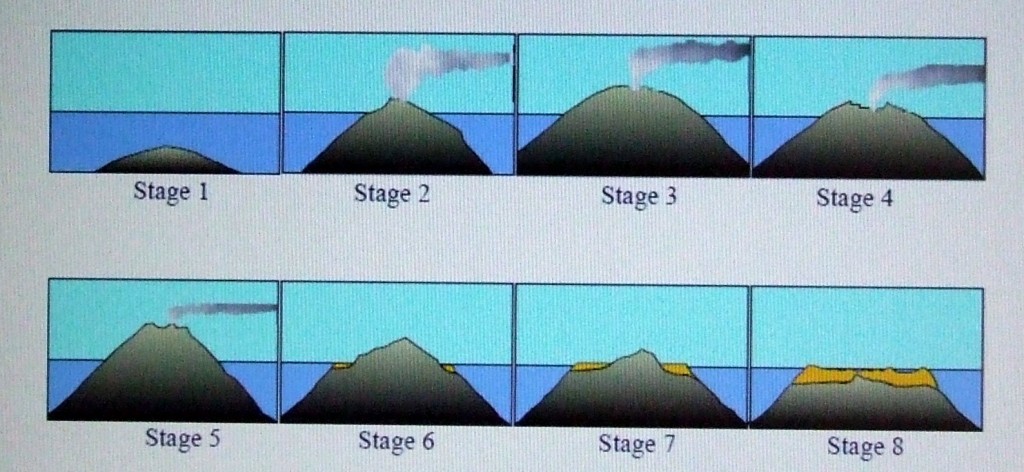
The real star of the Monument is the coral polyp.

I sat in on a lesson that Tanya was giving to some local children about polyps and finally started to understand how the coral fits into the picture of the life of an island. The coral keeps growing around the islands, even as the islands erode away.

(c) NOAA .The coral is shown as yellow

After awhile, all that is left is coral and the rock is under the water. But that’s okay, because the coral reefs create homes for all sorts of ocean critters.
(c) NOAA

The reefs also help form sandy islands – like the one that the green sea turtle was born on. And it all starts with a tiny coral polyp – small but mighty!

I’ve had a great time here, but Sam says I still have all sorts of cool places to visit, and we need to get going. Aloha Hawaii!

Wednesday, 3 March 2010

Hawaiian Islands, born from volcanoes

Aloha

Linda took me up to see an erupting volcano today! I was a bit nervous about this but I hardly even realised that I was on one, until I saw all of the gases and steam coming out of the top at Halemaumau crater. England, where I come from is an island and it was cut off from the rest of Europe when sea levels rose after the last ice age. I thought all islands were made the same way until Linda explained. Then I realized, ALL the Hawaiian Islands were formed by volcanoes! That’s a lot of volcanoes.

This island has several that still erupt, creating new land. The rest of the Hawaiian Islands’ volcanoes don’t erupt anymore and are eroding away. But Linda said that’s natural. It’s all part of the life of an island born from a volcano.

Tanya explained that this volcano that I am standing on is where all of the islands were born. It’s over something called a “hot spot” and the land I’m on is called the Pacific plate and is moving very slowly over it - really slowly - about as fast as your finger nails grow which is only about 3 ½ inches a year.

You may remember I learned about these plates back in Cordell Bay when I found out about the San Andreas Fault. The hot spot is where the lava comes up through the earths crust. The hot spot stays where it is, but the plate moves, so over a very long time a whole line of islands are created. Tanya told me that the islands that are part of the Monument are ancient volcanoes covered in coral.

Now, I started to get a little confused at this point, so decided to do a little tree climbing instead. Nothing like climbing a tree to clear the old head.

Here I am in this Ohia tree, a flowering evergreen tree which is only found on 6 of the Hawaiian Islands.

Bye for Now, Ed

Island Exhibit Meeting

That was all great fun but Sam and I were here to work, not just to sight see. Hawaii Volcanoes National Park and the Monument are working together to make some exhibits that will help people understand the entire Hawaiian Island chain.
Being from an island myself, I had lots to contribute.

Tuesday, 2 March 2010

Papahanaumokuakea Marine National Monument Mokupapapa Discovery Center, Hilo, Hawaii

Aloha

Sam and I arrived in Hilo today, on the Island of Hawaii (its nickname is the “Big Island”). I met Linda and Tanya, who work at Mokupapapa Discovery Center. They help teach people what the Northwestern Hawaiian Islands are all about.

(c) National Oceanic and Atmospheric Administration. Map showing all of the National marine Sanctuaries, some I have visited some I have yet to visit. The yellow trail shows Ed's travels thrpugh the sanctuaries so far.

They have a long Hawaiian word for the area – Papahanaumokuakea Marine National Monument – which I had to practice saying the whole time I was here.

(c) National Oceanic and Atmospheric Administration. Map showing Northwestern Hawaiian Islands

I thought Hawaii only had a few islands – but it turns out it is huge about 1,600 miles long! That’s the distance from London to Istanbul! Wow.

Can't wait to have a look around at this beautiful island.

Bye for now Ed and Sam