Showing posts with label NOAA Sanctuaries. Show all posts

Saturday, 19 June 2010

On my way to NABS YES

Hi all

Next stop will be the NABS YES at Florida. NABS stands for National Association of Black Scuba Divers and YES is the Youth Education Summit.

I have enjoyed the different sites I have visited here in the US more than words can say (but if you have read my earlier blogs you should at least have some idea). Even so, I have been particularly excited about the chance to visit and take part in the Youth Summit since I first heard about the project earlier in the year.

I am looking forward to meeting Ken Stewart who has been making a short video clip about my adventures. Ken is the Programme Director (and co-founder) of the Tennessee Aquatic Project (TAP).


TAP is a program that helps at risk and inner city youth, aged 8 to 18 year, to connect to diving and the ocean. Even more importantly, TAP provides a complete approach to personal development and support system which I am told will help them change their lives for the better. The ocean is a great way to make this happen as it is a place that is both exciting but also still holds many mysteries and of course we are all connected by the ocean too!

To find out more about the TAP project, follow the link below

http://tennesseeaquaticproject.org/

Ken has been using my adventures to help teach his TAP students about the ocean. Ken and the students have been following my adventures when they meet each Saturday. My visit to the Youth Summit will mean that they will become part of my adventures as well.
I am really proud to have the chance to be involved in this very special project and can’t wait to meet everyone – including the kids who appear in the Ed the Bear video clip Ken has been working on.

Bye for now, Ed

Friday, 30 April 2010

Welcome to the Florida Keys National Marine Sanctuary

Hi all

It was a long journey, but I have finally made it to the Fabulous Florida Keys! Sanctuary Sam and I flew into Key West to visit the Florida Keys National Marine Sanctuary; home to the world’s third largest barrier/bank coral reef. Wow, I didn't realise that the USA had such big reefs.

As we gazed out of the airplane window during descent, it seemed like the pilot was going to land us right in the water! Thankfully, there suddenly appeared what seemed like hundreds of small, flat islands covered with bushy trees (I later learned that these trees are called mangroves). The water looked very clear and shallow, and as we got lower we were surprised to see a large stingray gracefully swimming just below the surface. As we flew south-east over the islands to make our approach to the airport, we even got to fly over the coral reef!
World Famous Looe Key Reef and Sanctuary Preservation Area as seen from the air


The coral reef here in the Keys looks a little different than the ones we visited in the South Pacific. Instead of the reefs surrounding tall, volcanic islands close to the shore, these reefs formed parallel to the mangrove islands of the Keys about five to ten miles from the shore on what locals refer to as the “ocean side”.
As you can see from the map, the islands run basically east-west underneath the Florida mainland. Key Largo is 50 miles south of Miami, and as you drive down historic US-1, it is about 100 miles from there to Key West. To the north is the Gulf of Mexico (or “gulf side”), and to the south is the Atlantic Ocean. We learned that the Florida Keys National Marine Sanctuary surrounds and protects over 2900 square nautical miles of coral reefs, vast seagrass meadows, and lush mangrove islands.
Tomorrow, we plan to visit the Sanctuary’s Visitor Center, The Florida Keys Eco-Discovery Center, to learn about the different habitats and animals that make this place so amazing.

Bye for now, Ed

Wednesday, 24 March 2010

Helping out with a Beach Watch Survey

Hi

I think Sam has been playing a joke on me because we are still at the Gulf of Farallones National Marine Sanctuary. Today Sam and I headed out with Gulf of the Farallones National Marine Sanctuary Scientist Jan Roletto on a Beach Watch Survey at Rodeo Beach just north of the Golden Gate Bridge.

Jan told me that Beach Watch is a beach monitoring program. Since 1993 the programme has trained volunteers to undertake two surveys each month of over 150 miles of sanctuary coastline.

More than 100 volunteers from all walks of life take part in Beach Watch. Beach Watch surveyors count live and dead animals at the beach, record levels of human and dog activity and look for oil or other signs of ocean pollution. This data is used to help protect the sanctuary. They can watch for changes, such as an unusually large number of dead birds on the beach and then look for clues as to what might be causing the change (lack of food or an illness, for example). Knowing what is “normal” by doing regular surveys also helps sanctuary managers have an idea of how an oil spill or other disaster affects our local beaches by having real “before” and after data to compare. Such data was extremely useful during the Cosco Busan oil spill in 2007.
Ed, Sam and Jan taking a break from the survey

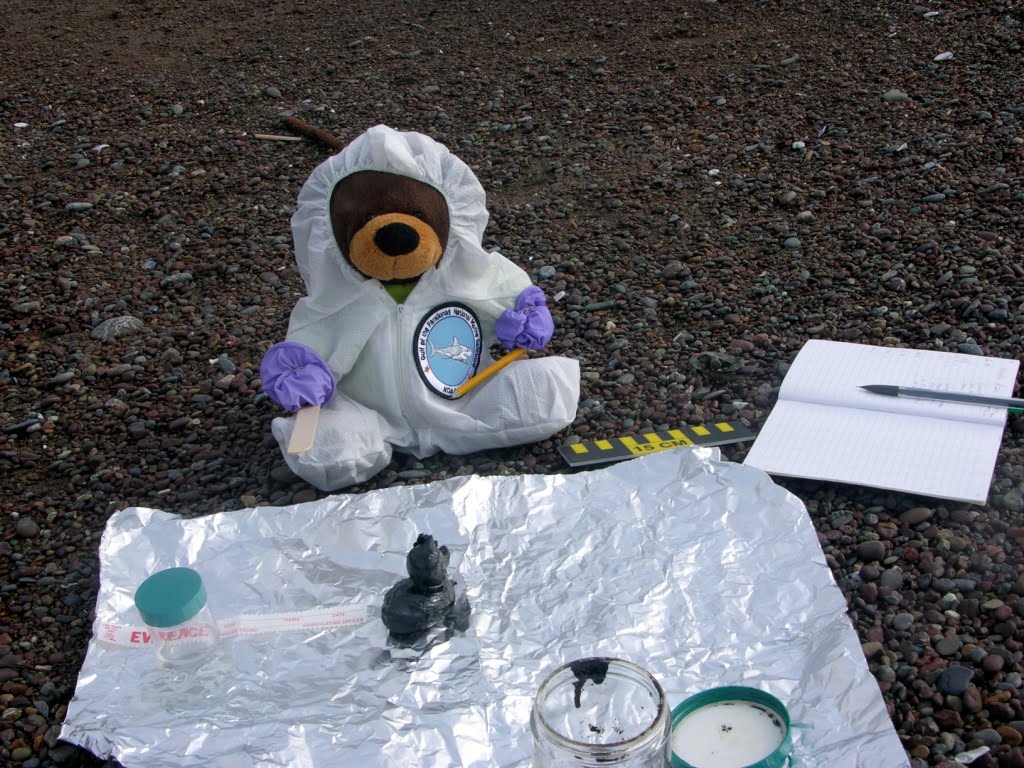
During Sam, Jan and my survey today at Rodeo Beach, we counted people, birds and marine mammals along the beach as well as any dead birds and mammals that had washed up on the beach. We also kept our eyes open for oil and marine garbage. Luckily there wasn’t any oil. I got to practice sampling oil on a previously collected oiled bird (a rubber ducky!).
I wore a specially made Hazardous Waste Operations and Emergency Response suit (HAZWOPER for short) with gloves to protect me from getting oil on my fur. (People use these suits so as not to get the oil or other toxic chemicals on their skin when involved in a cleanup.)
Counting birds at bird rock, just off Rodeo Beach

Collecting data ona dead bird

Jan said today was a historic survey, because we had the first recorded sighting of a sea otter off this beach. Sea otters are rare north of the Golden Gate Bridge, although in olden days they were quite numerous in this area. Jan explained that before being hunted for their fur in the 1800’s and early 1900’s, sea otters were found all along the Pacific Coast of North America, from Mexico up to Alaska. In 2007, the annual sea otter count found just over 3,000 sea otters in the central California coast, down from an estimated population of 16,000 before they were hunted for their fur. Jan explained that the California's sea otters are the descendants of a single colony of about 50 southern sea otters discovered south of Monterey in 1938. Now they are typically found from Santa Barbara to San Francisco, a very small portion of their former range. Ypou can see a pocture os sea otters in an earlier blog entry 17th February 2010 called "The Science of Surfing." Today’s sighting means they may be expanding their range a bit – it is a hopeful sign!

See you tommorow

Ed and Sam

Friday, 26 February 2010

Ed arrives at the Hawaiian Islands Humpback Whale National Marine Sanctuary

Hi all

Sam and I have arrived at the Oahu office of the Hawaiian Islands Humpback Whale National Marine Sanctuary, we were both feeling a bit stiff after our long journey. We were met by the office mascot, Henry the Humpback, who greeted us straight away and wisked us away for a tour of the office—the staff here barely had a chance to say hello! We had arrived here to take part in the annual ocean humpback whale count.

Henry seemed very excited to have company! Henry gave us each whale hats as a welcome present, which fitted perfectly. To help with the humpback whale count we would need to know more about the whales here and the sanctuary. As we toured the office we learned lots of interesting facts about the sanctuary: where its boundaries are and that it covers 1,370 sq. miles of ocean.

We also learned that the humpback whales are not found on the sanctuary all year round. Infact most of the humpback whales migrate thousands of miles to the Hawaiian Sanctuary from their rich feeding grounds around Alaska. There is lots of food for them in the summer, krill a type of shrimp that lives in vast shoals like fish. They catch this krill by filtering it from mouthfuls of water using baleen - this is what humpback whales have instead of teeth. We eevn got to touch a piece of real humpback whale baleen.

However, its not a good place to give birth to baby whales so they swim all the way to Hawaii where the waters are warm and calm.

I asked Henry if we had a good chance of spotting a whale. Henry told us that up to 12,000 whales come here annually between November and May. The breeding grounds here are also especially important since humpbacks are currently on the Endangered Species list though their numbers are recovering.

I was amazed to find out that the whales don’t eat while they’re here in Hawaii, which can be several months. My stomach started to rumble just at the thought of it. The adult humpback are beautiful blue/black colour with white tummies and flippers. But guess what, a baby humpback whale is completely white when its born.

Henry even showed us his very own picture in a book on Hawai‘i’s humpbacks of when he was a calf—Henry himself was born here in Hawai‘i!

Sam and I took over in the sanctuary for the sanctuary’s superintendent, Naomi McIntosh, for part of the morning and she was very impressed with how we were running things. The staff here thought we made a great team!


After a short meeting with two other very important representative members of Hawai‘i’s native wildlife—Harry Honu (a sea turtle) and Malia Monk Seal—in which we talked story and Sam and I impressed them with tales of our travels so far, we were all ready to call it a day! After all, the next day was the sanctuary’s most important volunteer project, the Sanctuary Ocean Count, in which volunteers from all around Kaua‘i, O‘ahu and Hawai‘i count whales and record their behaviors from shore. This information is then compiled with data from the other counts over the past 15 years and can give us important information about the numbers of whales that visit each year and how they are using Hawai‘i’s coastal waters. Me and Sam are here to volunteer as well, so we had better have an early night.

See you all tomorrow for the whale count, Ed and Sam.