Showing posts with label NABS Youth Sumit. Show all posts

Friday, 25 June 2010

Day 5: Final day of the Youth Summit, but still time for a dive

Hi all

Today is the last day of the Youth Summit. Unfortunately the plan had been for the last dive of the week to be at a underwater sea laboratory called the Aquarius .The Aquarius is run by NOAA and NURF.

Aquarius is in 60 feet of water and is protected, you can not drive a boat or fish within 5 hundred yards of Aquarius. You also have to have special permission to dive there. We had permission but mother nature would not cooperate. The waves were 6 feet, too high for the Youth divers. So we went to a very popular reef called Molasses Reef. Under normal circumstances this is a great dive, with visibility 70 to 80 feet , every kind of marine animal you could think of is there. Again Mother Nature was not as kind as this day. Molasses Reef the visibility was way down to 20, 25 feet. We made the best of it and dove. I went down in my diving bubble and Ken Stewart filmed some video footage. I will add it too my blog later.

After the dive everyone had the afternoon off so they could get ready for the Banquet.
The Youth Summit always ends with a closing banquet so the youths can be presented with different awards.

Jessica Silk was awarded Female Diver of the Summit. Seen here with Ken Stewart, Dan Orr CEO of Divers Alert Network and Cathy Sakas of NOAA.
Martin Lampkin awarded Male Diver of the Summit with Ken Stewart, Dan Orr CEO and Cathy Sakas.
Evan Mann receives his Master Diver certification with Ken Stewart, Dan Orr CEO and Cathy Sakas.

Guess what, I got a certificate too, for being an outstanding marine Environmentalist.
Here I am receiving my certificate from Lisa
I did not expect that, I was speechless which is very unusual for me. We had quite an honor Dan Orr CEO of Divers Alert Network{DAN} was our guest speaker.
 
A group from Africa

During the week Ken was told there were a group of folk from South Africa , who where invited to the banquet, including a Representative of the South African Government {Ratanang Maremane}
Ratanang Maremane
 
There was a great excited buzz in the air. But eventually it was time for everyone to go off to bed ready for an early start back home. I had an amazing time at the youth summit and made lots of friends and they all looked after me. I must give a special thanks to Lisa who took great care over the last couple of days - you may have noticed Lisa in many of the pics of me.
The Youth Summit Banquet Group 2010

It will be sad to leave but I also must be on my way. Next stop for me and Sam is the Channel Islands National Marine Sanctuary.
 
Bye for now, Ed

Thursday, 24 June 2010

Day 4: Coral reef diving, exploring an Indian village, alligator wrestling and airboat ride

Hi all

Another fun packed day of very different experiences; diving, a visit to a Miccosukee Indian village, alligator wrestling (luckily this was an activity we watched and did not have to participate in) and an airboat ride. Mario wrote a great blog that sums up the day perfectly. So just sit back and enjoy.

Mario's Blog
Today I started off heading toward Bache bay to scuba dive in the coral. It was about an hour ride out to our dive spot.
Due to the windy weather and turbulent winds we had to choose another spot. Bache had an average depth of 10-13 feet. The visibility was low but the dive was still enjoyable.
I dived about 29 minutes on my first dive, but the adventure didn’t stop there! We navigated our way to another dive spot called the shrimp boat. A nurse shark lived here but neither my friends or I was able to spot it. The surge continued its turbidity in this dive as well. The shrimp boat wreck could be found just off the anchor line of the boat. This dive was shortened because of the lack of remaining air in our tanks(we dived two areas with one tank). The coral reefs found in both of these areas were very colorful and abundant. To abstain from causing harm to the reefs I had to stay a good distance above the reefs.

The following photographs of undersea life were taken by the NAB Youth, I think they did a great job, Ed
Beautiful coral and sea fans
          
Brain coral
 More coral
 Sea fans

French angelfish
Two French angelfish
More corals
A small grouper lurking
Lobsters on the shrimp boat site

After diving and getting some lunch, we headed over to the Miccosukee village to learn about the heritage and history of the Miccosukee Indians.
Our tour of their village started off with our guide starting a fire the traditional Miccosukee way! We all sat around in a Chickee as our guide set up a pyramid of cut wood and our guide started a breeze to incite the embers.
It wasn’t long before we were being warmed, not only the growing fire but the passionate past and the current struggle of the Miccosukee Indians to remember to not only remember their ways but to pass it along for the centuries to come. Miccosukee women spent most of the village teaching the daughters and cooking the animals hunted by their husbands and the growing sons.
Miccosukee women with different things to sell
The Miccosukee people use sewing machines to sew fabric

Miccosukee hand made dolls
Me with Sam and Lisa by a beautiful totem pole

I was shown the unique way in which a canoe was crafted, if done right, it would last over 25 years.
Miccosukee canoe

A conch shell was wedged and driven into a tree until the tree split in half. Afterwards the center of the tree was burned to make it easier to carve.
It would usually take an average of six months to finish, but if done right, it was worth the time and effort. This same skill was set upon carving toys for the little boys and girls of the village; I was shown a toy boat and a training boy for young boys.


The girls of the village didn’t get off easy though! We were shown many patterns unique to the tribe. These were done by hand in the older times of the village. The triangles represented the water and there were bird designs as well. We were also shown the crops native to the land and the crops that were brought by the Spanish.
Me and Lisa

We finally made our way the alligator show. Here the alligator wrestler performed feats that defied logic and our wildest imaginations.
We were shown the ancient way in which the Miccosukee Indians captured the alligators and took them back to the village. The wrestler straddled the 250 lb. alligator and grabbed the mouth and placed it between his chin and chest, simulating a way to free the hands and tie up the alligator.
The wrestler also opened the jaws containing 80 teeth and placed his hand in the alligator’s mouth. He withdrew his hand with a split second to spare as the jaws snapped shut with a pressure so great, it’s thump was heard throughout the stadium. He continued to do this trick three more times! Finally the wrestler performed a trick called the face-off., meaning that if there was one false move the alligator would snap his face off,.
We all trembled on the edge of our seats in anticipation as the alligator wrestler placed his face and hand into the gaping jaws of the beast. The stadium erupted as the audience clapped and took pictures of the amazing feat.

Finally, my trip ended with an airboat ride.
Putting cotton wool balls in our ears

The boat was able to reach speeds of 35 mph! As we ripped through the water, glimpses of the beautiful view flashed through my eyes.
Thanks to the cotton balls in my ears, I was able suppress the sound of the boat.

As I headed home I reminisced on the fascinating memories I had made an the change that occurred within in me as I added to my knowledge, but most of all my experiences and the wisdom it wold provide me in the future.

Wow, another amazing day and all the more enjoyable being with my new friends. I enjoyed the diving and seeing all the beautiful coral and fish. The visit to the Miccosukee was also very special. As you know I have also visited other Indian villages on my tour, in particular the Port Gamble S’klallam Tribal Reservation (Washington State) with friends Ron Hirshi and Fred the Monkey and also Taholah in the Quinault Indian Nation during my trip to the Olympic Coast National Marine Sanctuary. The crocodile wrestling was fascinating but a bit scary. The airboat ride was amazing skimming over the water, I'm glad they gave us ear plugs because the airboats are really noisy.

Bye for now, a very tired Ed.

Monday, 21 June 2010

Day 1 A morning of experiments at Amy Slate Resort

Hi all

I have already made lots of friends at the NABS Youth Summit and I am looking forward to learning lots of great stuff with them over the next few days. As I will be working with the youths and we will be learning things together, I have decided that it would be great to ask the youths to write some of my blog entries for me.

We made an early start, departing the hotel where we were staying and drove 20 miles to Amy Slate Resort. We were greeted by the staff of the resort and Florida Keys National Marine Sanctuary staff.

During the morning we would be undertaking activities at five different stations. At one station we would learn about the salinity by collecting water samples, oxygen dissolved in seawater, a weather station, collecting water samples from deeper water (without getting wet) and measuring how cloudy the weather is.

SALINITY STATION
Students collect water from the Gulf of Mexico side of Key Largo to determine the salinity of the water. They place water drops on the plate of their refractometers and peer through the eyepiece to read the scale inside to determine the percentage of salt contained in the water. Ocean water is typically 35 parts of salt to 1000 parts of freshwater usually recorded as 35 ppt. Freshwater of course registers at zero. The higher the salinity, the more buoyant swimmers and divers will be.

DISSOLVED OXYGEN STATION
This is the dissolved oxygen station

Disolved Oxygen Station, me. Chanel, Octavia, L Whitney

Hi my name is Ed Bear and I’ve got a riddle for you.


If five fish are swimming and two of them drown. How many fish are left? If you’ve heard this riddle before and answered “Five, because a fish can’t drown.” I hate to say it but you’re wrong. Fish can drown. You’re probably wondering how because fish breathe water, don’t they? Well no they don’t. They breathe oxygen, dissolved oxygen to be exact and if there’s no dissolved oxygen that poor fish will drown.


In Key Largo I was given the chance to learn how they measure dissolved oxygen. In order to measure dissolved oxygen you take a small glass vial filled with a special chemical that turns blue when it touches water with oxygen in it. You place the vial in a plastic tube that looks sort of like s syringe. Place the tube in the water and push down on the vial to break the seal.
This is kind of hard for me to do because bears don’t have opposable thumbs but you should have no problem. The water will then come rushing into the vial and start changing color.
The bluer the solution, the more oxygen present in the water. As you may imagine the water at Key Largo was a deep blue with dissolved oxygen measuring at about 4 parts per million (ppm). Giving the fish enough oxygen to breathe comfortably and not drown.


This entry was written by Octavia Shaw

WEATHER STATION
Weather Station – At the weather station students read air and water temperatures, wind speed or velocity, the barometric pressure and the level of humidity or the amount of moisture the air is holding. Weather data is important to record when doing any kind of field work since weather influences and affects everything we do and all organisms on our Ocean Planet.

Ed Bear here, in Florida they are constantly looking out for changes in the weather to ensure they are prepared for future weather disasters. We were able to calculate the percentage of clouds in the sky by imagining all the clouds pushed together in the sky and determining how much of the sky they will occupy. We felt that the percentage of the clouds were about 45%. We also had a chance to measure the wind with an anemometer. This device is a tall cylindrical tube that has two holes on one side (one close to the top and one close to the bottom). This gave us fairly precise measurement of how much wind is blowing. Last but not least we measured the direction of the wind using a compass. Turns out we found the wind to be blowing east. You can learn so much with the weather.


This entry was written by L’Whitney Gowans

SECCI DISK STATION
Every time you go to the Keys, you ALWAYS learn something new. Especially when you learn some new crazy name about a tool used for visibility or depth. That tool is the secci disk.

It is a black and white plastic disk that is connected to a measuring tape (just as simple as it sounds). To start the calculations, we lowered it down into the clear water and watched as it was harder to see as it decended into the unknown. I, Ed bear, however could see that the “unknown” was actually some bare substrate on some rocks and covered in algae. Measuring the visibility from the disk was actually harder then looking into that “unknown”. (You may remember I watched some students using this last time I was here)


How you measured it was, you had to find out how far the disk was from the water, subtract that from the actual depth (using the secci disk of course), and finally you have successfully accomplished your task. I bet I would have learned more at the station if I wasn’t whisked away to the next but what I did get out of it was this; don’t underestimate the power of a plane plastic disk. It could just be the scientific fact that could solve a disaster.


This entry was written by Jessica Silk (SCUBAnaut)

NISKIN TUBES STATION
Niskin Tubes. Ashley, Evan,Kwadjo, Terrance, Massai, Teaon

Hello everyone this is Ed bear, and I’m enjoying the sun shine state in the Florida Keys with NABS/YES. Today we learned about a variety of subjects having to do with Water quality testing methods NOAA uses in there Marine Sanctuary. One of those methods was the Niskin bottle; I used it to retrieve water from depth to be tested. The device is spring loaded and so when it reaches the right depth, you use a small weight to set off the release of the closing system, by sending it down the retrieval line.


The container then closes and traps about a litre of water inside and can then be hauled back to the surface. The Niskin bottle can be used on a boat or from shore making it versatile and it appears to be made from sturdy replaceable materials making it a perfect tool for a range of environments. In a real life testing situation you would then take that water and test it at the other stations. I worked hard to get the system to function
correctly, and eventually I was able to increase my skill and take a sample from the dock water where we practiced. I learned many skills to day the Niskin bottle was one of the trickiest


This entry was written by Wadjo Tillman

Today at the youth summit we had a blast! The day was organized by different learning stations. We learned about dissolved oxygen, water salinity, and secchi disk. In the lab about dissolved oxygen we leaned the importance of having it in the water, and the way that the levels are measured. The water salinity station, which was taught by Mrs. Cathy Sakas, was also very interesting. We learned the scale that is use to measure the amount of salt in the water, and how to read the information that we collected using the Refractometer. One of the last stations that we went to was the secchi disk, which is used to measure the clarity of the water. It’s very simple; all you do is lower the disk into the water until you can’t see it anymore. Then you record the depth to where you could no longer see the disk. Then look at the scale that is provided to see find the clarity of the water. Over all we had a great day and learned a lot. I can’t wait to see what we get to do tomorrow.


This entry was written by Bresha
Wow we found out so any things about the ocean and much of the equipmemt was quite tricky for a bear with such little paws, so it was great to have help from my new friends. And that was just the morning! Ed

An afternoon of snorkelling

Hi all

After the NABS/YES youth went through their 5 stations, we all went snorkeling. They were all too excited to write a blog on this, as this was the youths first chance for snorkeling, but I think the pictures speak for themselves.
We went out on the boat, Amoray Diver.
Sanctuary Sam helped to drive the boat. (He did quite well, at least we didn't hit anything).

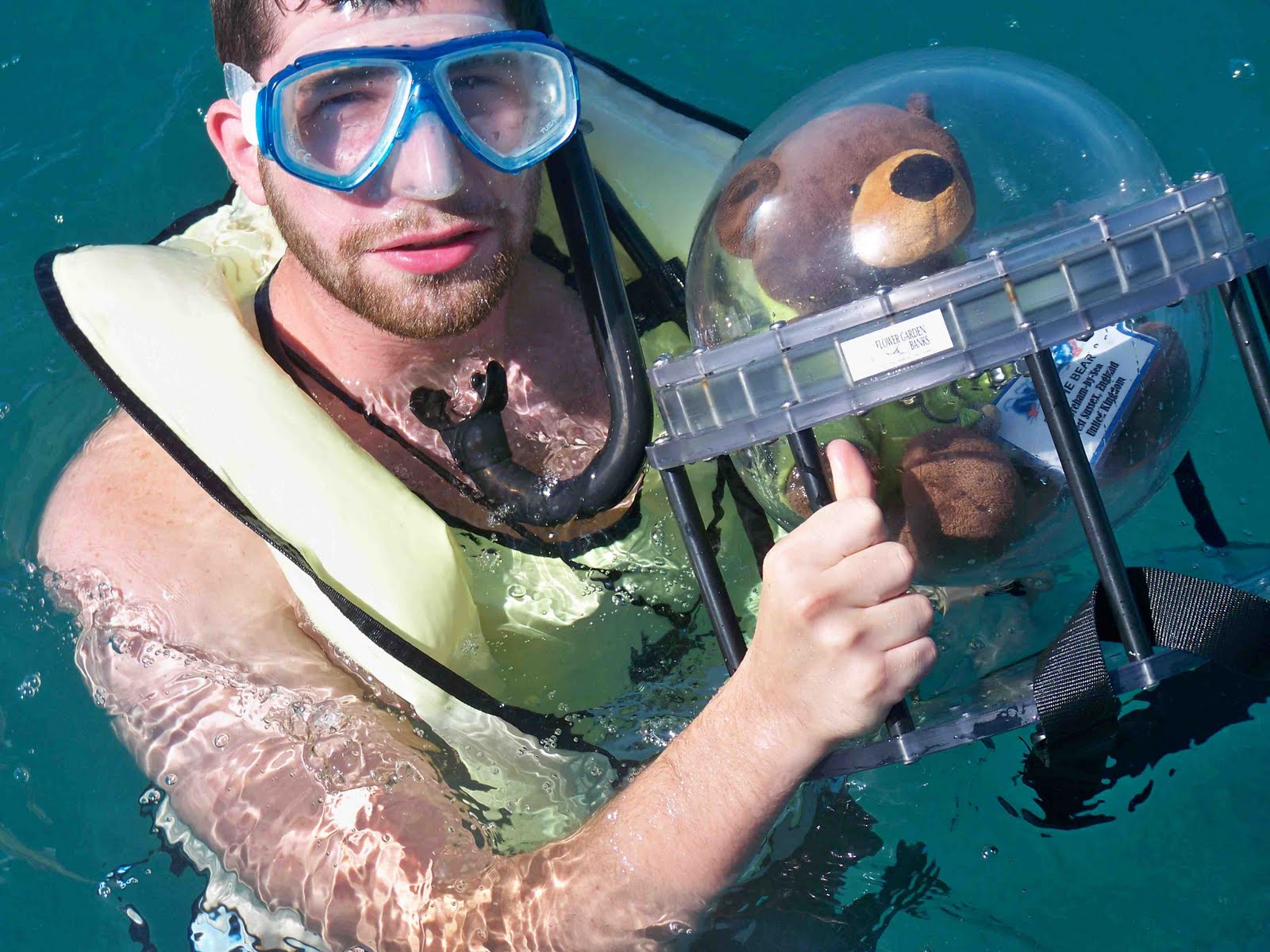
I got the chance to go out with them with my underwater diving bubble. Matthew Taylor from NOAA took care of me much of the time.
Me and Matthew

Here I am with Matthew and the YES Youths, they look like they are having great fun!

As you can see, the water was a lot more cloudy than when I was here last, I felt like a living secchi disk
I was glad Matthew was keeping an eye on me as I was a bit worried I might get lost and no one would be able to find me.
We didn't use any diving weights this time so  could easily pop back up to the surface, Matthew as well if he was holding on - weeeeeeeeeeeeeeeeeeeeeee.

This is me on the coral reef with Ashley

Here I am with the the YES Youths.
Here I am back on the surface with Ashley and Kwadjo.

Eventually it was time to go, the snorkeling trip finished our day. It was such fun and great to have the company of my new friends.

I'm feeling a bit peckish after all this excitement. Time for a honey and banana sandwich and off to bed. I here it will be another busy day tomorrow. Ed